


What if the difference between a “nice” sketch and a professional masterpiece isn’t raw talent, but the ability to harness light and atmosphere through a few specific technical shifts? You’ve likely mastered the basics and can comfortably fill a sketchbook, but you might feel stuck on a creative plateau where your perspective feels slightly off or your colours lack that professional depth. It’s a frustrating stage where you know what you want to achieve, yet the results don’t quite match the vision in your head.
This guide explores how our art classes for improvers Cheltenham can help you bridge that gap, moving you from representational drawing to truly atmospheric storytelling. We’ll look at mastering tonal control, refining your use of perspective, and building a cohesive body of work that reflects your unique artistic voice. By focusing on professional techniques with expert, patient guidance, you’ll find the quiet confidence to elevate your craft and finally produce work that resonates with the same tranquility and character found in fine art galleries. You’ll discover how to move beyond basic skills and master the subtle nuances that define a professional finish.
Key Takeaways
- Recognise the signs of a creative plateau and learn how to transition from basic representational drawing to atmospheric, professional-standard storytelling.
- Master advanced techniques such as “lost and found” edges to create focal points and bring depth to complex architectural landscapes.
- Discover why professional art classes for improvers Cheltenham offer greater long-term value than general community groups through expert, tailored feedback.
- Learn how to organise your home practice using a structured framework that balances technical drills with free-flowing creative exploration.
- Understand the importance of a tutor’s professional background and how qualified mentorship can help you build a more cohesive and confident body of work.
Identifying the ‘Plateau’: Why You Need Art Classes for Improvers in Cheltenham
Reaching a creative plateau is a common experience for many local hobbyists. You’ve moved past the initial hurdle of learning which brush does what, but your paintings still feel “flat”. This is the hallmark of the improver stage. It’s a point where you have technical knowledge but lack the professional polish that brings a scene to life. You might find that your perspectives are technically correct, yet the image lacks that elusive sense of atmosphere. This is precisely where art classes for improvers Cheltenham become essential. While a beginner class focuses on the basics, an improver session challenges you to look deeper into the soul of your subject.
Most people “look” at a house or a tree and try to replicate it exactly. A professional artist “sees” the interplay of light, the weight of the shadows, and the temperature of the colours. This shift in perspective is what separates a literal copy from an evocative piece of fine art. It involves understanding how the atmosphere affects the objects in the distance and how light bounces off different textures. It’s about feeling the character of the scene before you even touch the paper.
The Difference Between ‘Beginner’ and ‘Improver’ Art Tuition
Beginner tuition is often about tool handling, whilst improver lessons focus on medium manipulation and emotional resonance. It’s the transition from following a step-by-step tutorial to discovering your own artistic voice. It’s no longer just about getting the paint on the canvas; it’s about how the paint is applied to create movement and depth. Working with a qualified art teacher allows you to receive bespoke feedback that identifies your specific technical gaps. Whether it’s a slight misunderstanding of tonal values or a struggle with a comprehensive list of artistic techniques, professional guidance ensures you don’t just repeat the same mistakes.
Moving Beyond Simple Representation
Copying from a photograph is a common trap for those moving beyond the basics. It often leads to stiff, lifeless results because the camera flattens the world in a way the human eye doesn’t. To elevate your work, you must learn to interpret rather than just represent. This means choosing what to leave out just as much as what to put in. It’s about creating a narrative within the frame. By mastering these nuances, you can begin to tackle more complex subjects like architectural commissions, where the goal is to capture the character of a building rather than just its dimensions. Professional mentorship within art classes for improvers Cheltenham provides the supportive space needed to take these creative risks and move toward a truly professional finish.
Key Artistic Techniques for the Advancing Student
Moving beyond the basics requires a shift in focus from “what” you are painting to “how” you are interpreting the subject. In our studio, we often use the architectural landscape as a primary vehicle for teaching these advanced concepts. Buildings offer a unique challenge in perspective and structure, but they also provide an excellent opportunity to practice observational drawing, which remains a fundamental skill in illustration. By mastering the structural integrity of a period property or a historic brick townhouse, you build the technical foundation needed to then apply more expressive, atmospheric layers.
One technique that distinguishes professional work is the use of “lost and found” edges. Beginners often outline every object with equal clarity, which can make a painting feel like a cut-out. By allowing some edges to dissolve into the background whilst keeping others crisp and sharp, you can direct the viewer’s eye exactly where you want it to go. This creates a sense of compositional flow, ensuring the eye moves rhythmically through the piece rather than getting stuck on a single, isolated detail. It’s these subtle transitions that give a painting its life and movement. Developing these skills alongside peers at a similar level is one of the key advantages of small group art tuition, where immediate feedback and shared observation accelerate your technical growth.
Mastering Atmospheric Perspective and Light
Atmospheric perspective is the method of using colour and value shifts to create the illusion of three-dimensional depth on a flat surface. To achieve this, you must learn to manipulate colour temperature. Warm tones, like ochres and cadmiums, tend to pull objects toward the viewer, whilst cool blues and greys push them back into the distance. This is particularly useful when trying to capture the soft, diffused “British light” that characterises many original landscape paintings. Understanding how light wraps around a form allows you to create a sense of volume and weight that simple line work cannot achieve.
Advanced Colour Mixing and Theory
As you progress in your art classes for improvers Cheltenham, you’ll find that less is often more. Moving away from a cluttered palette toward limited colour selections helps maintain harmony across your work. This approach is vital for mixing “clean” neutrals and shadows. Instead of reaching for a tube of black, which can deaden a painting, you’ll learn to mix vibrant, deep tones using complements. This skill is especially important in traditional portrait painting commissions, where the emotional resonance of the piece depends on the subtle, translucent qualities of skin tones. If you’re ready to refine these nuances, exploring the structured environment of Brian Crosby Art can provide the tailored guidance you need to see real progress.
Choosing Between Community Groups and Professional Art Tuition
When searching for art classes for improvers Cheltenham, you’ll likely find a choice between relaxed community groups and professional art tuition. Both have their place in the local creative scene. A volunteer-led club offers wonderful social connections and a mutually supportive environment for hobbyists. However, for those wanting to break through a technical plateau, the value of professional mentorship is unmatched. In the UK, the cost of expert-led lessons reflects the years of training and professional practice the tutor brings to the table. It’s the difference between “painting alongside” others and receiving a structured education designed to elevate your specific technique.
A key factor is the tutor’s own professional standing and their connection to the wider art world. Learning from an artist active in the Society of Architectural Illustrators ensures you are being taught to high industry standards. These professional memberships aren’t just badges; they represent a commitment to technical precision and atmospheric quality that generalist groups often miss. Small group sizes are equally vital. In a room of twenty, you might get five minutes of attention. In a small group or one-to-one setting, every brushstroke is seen and every challenge is addressed with tailored feedback. If you want to understand exactly how an intimate learning environment can transform your practice, our complete guide to small group art tuition explores the balance between professional mentorship and peer inspiration in depth. Understanding the benefits of one to one art tuition can help you decide whether a more personalised approach is the right investment for your creative growth.
Evaluating Tutor Expertise and Qualifications
Look beyond the educator’s certificates and examine their portfolio. A professional artist who handles commissions daily understands the practicalities of composition and light in a way a generalist might not. Live demonstrations are a hallmark of quality tuition. Watching a tutor resolve a complex shadow or refine a focal point in real-time is far more instructive than purely verbal instructions. These professional experiences directly inform the teaching methods, providing you with “insider” knowledge on how to achieve a gallery-standard finish whilst developing your own personal style.
Assessing Studio Facilities and Group Dynamics
The environment where you learn significantly impacts your focus. A dedicated professional studio provides the right lighting, equipment, and quietude required for deep creative work, which is often missing in a drafty community hall or a busy public centre. Group dynamics amongst fellow improvers also play a role. There is immense value in peer feedback when everyone is working toward a similar level of mastery. We strive to maintain a neighbourly and welcoming atmosphere whilst upholding high artistic standards. It’s about creating a space where you feel comfortable enough to fail, knowing that each mistake is a guided step toward your next breakthrough in your art classes for improvers Cheltenham.
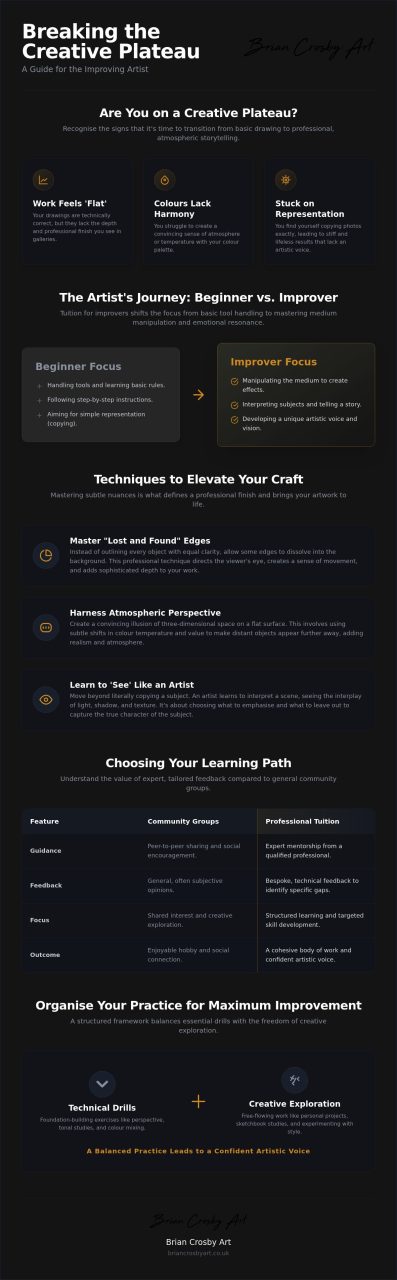
How to Organise Your Practice for Maximum Improvement
Weekly lessons provide the initial spark, but the creative fire is kept alive through a structured home practice. To get the most from art classes for improvers Cheltenham, you need a framework that bridges the gap between the studio and your own creative space. This isn’t about hours of gruelling work; it’s about a thoughtful balance between technical drills and pure creative exploration. By organising your time effectively, you ensure that the professional techniques learned in class become second nature.
Think of your practice as two distinct modes. One session might involve technical drills, such as practicing the “lost and found” edges we discussed earlier or mixing clean neutrals from a limited palette. Another session should be dedicated to creative play, where you apply those skills without the pressure of producing a “finished” piece. Your sketchbook is your best ally here. It shouldn’t be a collection of masterpieces. Instead, treat it as a working document of observations. Use it to record the way light hits a local chimney stack or the subtle temperature variations in a morning sky. Regular critique sessions with a professional mentor then help to refine these raw observations into polished, gallery-standard techniques.
Setting Realistic Creative Milestones
Large goals, such as completing complex architectural landscapes, can feel overwhelming. Break these down into manageable milestones. If your ultimate goal is a house portrait, spend a week focusing purely on the perspective of the roofline or the texture of the brickwork. Track your progress with before-and-after comparisons. Seeing how your tonal control has improved over a month is the best antidote to the creative plateau. Remember, a plateau is just your brain catching up with your eyes. It’s a natural part of the learning cycle that often precedes a major breakthrough.
Developing a Consistent Studio Habit
Consistency beats intensity every time. You don’t need a grand studio; a dedicated “art corner” with decent natural light will suffice. If you’re short on time, use the “15-minute rule”. A quarter of an hour spent on a quick tonal sketch keeps your momentum high and your hand-eye coordination sharp during busy weeks. Periodically curate your own work. Lay out your sketches from the last month to identify recurring technical themes or areas that still feel “flat”. This self-reflection, paired with expert guidance, is the fastest route to technical mastery. If you’re ready to build these habits under professional guidance, join our art classes for improvers Cheltenham to start your transformation.
Elevate Your Craft with Expert Mentorship from Brian Crosby Art
The Brian Crosby approach is built on the belief that professional art education should feel like a warm invitation rather than an exclusive club. We strike a balance between high-level expertise and a neighbourly, supportive delivery. This ensures that the world of fine art remains accessible to everyone. Whether you are just starting or searching for art classes for improvers Cheltenham, our lessons are carefully tailored to your current skill level. We don’t believe in a one-size-fits-all curriculum. Instead, we focus on your specific goals, helping you find steady progress through a patient and encouraging process.
By integrating architectural and portrait techniques into our general art tuition, we provide a rich, textured learning experience. This isn’t just about learning to paint; it’s about joining a community that values quality and personal connection. We invite you to linger on the beauty of the process and explore your creativity at your own pace. The goal is to foster a sense of tranquility and appreciation for the craft, moving away from the pressure of “perfect” results toward genuine artistic growth.
Personalised Instruction for Architectural and Portrait Work
Learning from a professional house illustrator gives you a unique advantage. Brian brings years of experience in architectural commissions directly into the classroom. You’ll learn how to handle the structural challenges of a building whilst maintaining an atmospheric, painterly feel. Portraiture follows a similar philosophy. We move beyond simply achieving a likeness to focus on capturing the true character and emotion of the subject. These professional methods are easily adapted for hobbyist mediums, such as watercolour or ink, allowing you to produce work with real depth and movement.
Integrating Professional Standards into Your Hobby
Even if you paint purely for pleasure, there’s immense satisfaction in producing work that meets professional standards. We believe that understanding framing and image restoration is just as important as the painting itself. These skills ensure your work is exhibition-ready and protected for years to come. It changes how you view your own creations. You begin to see yourself not just as a student, but as a skilled craftsman. If you’re ready to take that next step, we’d love to hear from you. You can enquire about our bespoke tuition or book a session directly through the website to begin your journey with our art classes for improvers Cheltenham.
Begin Your Journey Toward Technical Mastery
Transitioning from a hobbyist to a confident artist requires more than just repetition; it demands a fundamental shift in how you perceive light, structure, and atmosphere. We’ve explored how mastering “lost and found” edges and refined colour mixing can transform a flat image into a piece with genuine character. By moving beyond simple representation and embracing professional standards, you’ll find that your creative output gains a new level of depth and sophistication. Our art classes for improvers Cheltenham provide the supportive, expert-led environment necessary to navigate this transition with ease.
As a Qualified Art Teacher and a Member of the Society of Architectural Illustrators, I provide bespoke tuition tailored to your goals. Whether you wish to master architectural landscapes or capture the soul of a portrait, my approach remains patient, friendly, and deeply rooted in professional practice. You don’t have to navigate the creative plateau alone. With the right mentorship, every brushstroke becomes a step toward a more cohesive and professional body of work.
Explore our art lessons for improvers and book your place today. I look forward to welcoming you into our creative community and helping you discover the tranquillity and satisfaction of elevated artistic technique.
Frequently Asked Questions
What is the difference between a beginner and an improver art class?
A beginner class focuses on foundational skills like basic tool handling and colour mixing. In contrast, art classes for improvers Cheltenham delve into advanced technical precision and atmospheric storytelling. Improvers already understand the basics but seek to master professional nuances like tonal control and lost and found edges. These sessions move away from step-by-step tutorials toward developing a personal artistic voice and interpreting complex subjects with greater character.
Do I need to bring my own materials to the improver lessons?
Many students at this level prefer to use their own brushes and paints to maintain consistency in their personal practice. However, basic studio equipment is often provided to support the learning process. It is best to check with the studio before your first session to see which specific mediums will be used. Using your own materials allows you to become familiar with their unique properties whilst receiving expert guidance on how to manipulate them effectively.
How long does it take to see a noticeable improvement in my painting?
Most students notice a shift in their technical understanding within four to six weekly sessions. Improvement is often non-linear; you might experience a plateau before a significant breakthrough in your tonal control or perspective. Consistent home practice, guided by professional critique, accelerates this growth. By focusing on specific milestones rather than general progress, you will see your work move from representational sketches to atmospheric, gallery-standard pieces more rapidly.
Are the classes suitable for those interested in architectural illustration?
Yes, these lessons are ideal for aspiring illustrators because they are led by a recognised member of the Society of Architectural Illustrators. You will learn the structural integrity required for buildings whilst mastering the atmospheric beauty of architectural landscapes. The curriculum integrates professional standards used in architectural commissions, teaching you how to capture the unique character of a structure rather than just its literal dimensions through precise observational drawing.
Can I get feedback on art projects I am working on at home?
Professional critique is a core component of art classes for improvers Cheltenham. Bringing in your home projects allows for tailored feedback that identifies technical gaps you might miss on your own. This bespoke tuition ensures your independent work aligns with the professional standards taught in the studio. It is an excellent way to maintain momentum between lessons and build a cohesive body of work that reflects your steady progress.
Is there a specific medium we focus on in the improver workshops?
The workshops generally focus on traditional mediums like watercolour, ink, or oils, depending on the specific course focus. These mediums are excellent for exploring the subtle nuances of light and shadow found in professional portraiture and landscapes. The choice of medium is often tailored to the individual goals of the student. This flexibility allows you to refine your technique in your favourite medium whilst learning how to apply professional-grade standards to every piece.
How do I know if my skill level is right for an improver class?
If you can comfortably handle your chosen medium and understand basic perspective but feel your work lacks polish, you are likely an improver. You might struggle with creating depth or feel your paintings look flat despite being technically accurate. These classes are designed for those who have moved past the beginner stage and are ready for the challenge of expert-led, technical mastery. A quick portfolio review can help confirm the best fit for your skills. If you find yourself craving more individual attention than a group setting can offer, it may also be worth exploring the benefits of one to one art tuition as a complementary path to accelerating your development.
[…] and finding a personal voice. A qualified teacher helps you navigate this transition, offering art classes for improvers Cheltenham that introduce new challenges just as you’re ready for them. It’s a steady, rewarding […]