


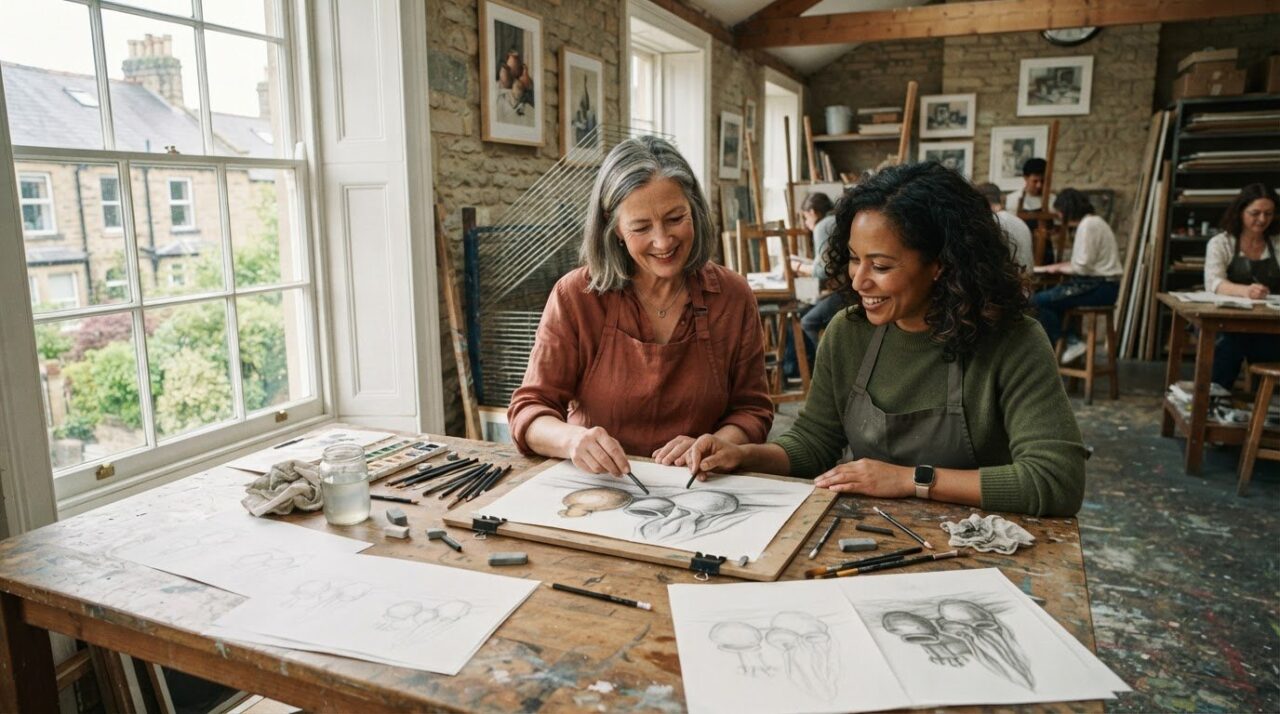
What if the next step in your art practice isn’t a harder subject, but learning to see more clearly? If familiar exercises feel repetitive and progress has slowed, it can be difficult to know which skills need attention. Art tuition for improvers gives you a chance to look closely at your work, identify what to practise and build on the foundations you already have.
Useful progress often comes from practising with purpose: strengthening observation, exploring technique and developing your artistic judgement. Supportive guidance can help you recognise what’s working and decide what to try next. You don’t need to arrive with a portfolio or have every goal mapped out. Qualified art teacher Brian Crosby tailors friendly lessons to each student’s skill level, making them a considered next step beyond the basics.
This guide explains what improver-level tuition can involve, how to make practice between lessons more purposeful and what to look for in teaching that suits your current abilities. With patient instruction and steady effort, your creative practice can become more focused, confident and rewarding.
Key Takeaways
- You don’t need to master the basics before seeking guidance; improver tuition builds on the skills you already have.
- Art tuition for improvers can give your practice a clear focus and help you make sense of feedback.
- A simple routine of making a study, reviewing it and noting a question can make practice between lessons more purposeful.
- Dated sketches or photographs can help you notice changes in your artistic decisions and confidence over time.
- Brian Crosby is a qualified art teacher who tailors friendly lessons to each student’s skill level.
Art tuition for improvers: what level are you, and what can you develop?
You don’t need to reach a particular standard before asking for guidance. An improver has some experience and wants to strengthen their skills, confidence or artistic judgement. You might already enjoy drawing or painting, but feel your work has stopped changing or you’re unsure what to practise next.
Improver-level tuition builds on what you already know and helps you choose useful next steps, without requiring a fixed level of mastery. There’s no single entry point that suits everyone. A specific aim helps, but it’s also fine to begin with a question about what to work on.
How to tell whether you are ready for improver art lessons
Notice what you can already draw, paint or observe with confidence. Perhaps you can capture the outline of a familiar subject but find its proportions difficult to judge. Maybe you’re comfortable with one approach but repeat it because you’re uncertain how to move on. These aren’t signs that you’ve failed to progress. They can point to a useful learning focus.
Not knowing which technique to use, or what to practise next, is itself a helpful starting point. You don’t need to be an advanced artist; a desire to develop is enough to explore lessons suited to your experience.
What can art tuition for improvers help you develop?
Your focus will depend on your existing skills and aims. You might practise observing shape and light, arranging subjects within a composition, judging proportion, making considered colour choices or handling materials with greater confidence. For example, if a drawing feels lopsided, compare the width and height of its main shapes before adding detail. A small change in how you look can alter how you approach an entire piece.
Drawing can be a useful place to strengthen these foundations. It helps artists explore line, shape and observation, and is described as a fundamental means of public expression. That doesn’t mean every improver needs the same exercises. Focused guidance can help you identify which fundamentals support your aims, rather than trying to master everything at once.
Brian Crosby is a qualified art teacher offering friendly lessons for beginners and improvers, with tuition tailored to each student’s skill level. If you’re deciding what you want to develop, begin by noting one thing you enjoy making and one part of the process you find challenging.
How improver art tuition turns practice into visible progress
Repeating a familiar subject can feel comfortable, but it doesn’t always show you what to work on next. Make practice more intentional with a simple cycle: choose a goal, focus on one skill, review what happened, then decide on a next step. If a still life feels unbalanced, for example, sketch the shapes and spacing first. Then compare that study with the arrangement you intended before attempting a more detailed piece.
Focused practice paired with constructive feedback helps you understand what’s working, spot what needs attention and choose a purposeful next step. This is the value of art tuition for improvers: not simply making more pictures, but learning to look at your own decisions with greater clarity.
Why observation and artistic decisions matter as much as technique
Careful looking helps you judge how shapes relate, whether proportions feel convincing and where light falls across a subject. Before drawing a mug, notice the width of its rim compared with its height, and how its handle sits against the body. You could make a quick outline, then check those relationships before adding smaller details. Observation gives technique something solid to work with.
Composition is how you arrange things within the picture. Moving a subject away from the centre, or leaving more space on one side, can change the balance and mood. Perspective describes how objects appear to recede into the distance: a path may seem narrower as it stretches towards the horizon. These are tools for making considered choices, not rules that dictate one style.
How useful feedback supports steady improvement
When you’re absorbed in making a picture, it can be hard to see patterns in your own work. Specific, kind feedback can draw attention to a strength, such as a lively line or a clear focal point, then suggest one manageable area to explore. The most useful observations connect with your aim rather than judging the work against someone else’s style.
Reviewing a piece this way makes it easier to compare what you intended with what appears on the page. Perhaps the proportions are close, but the light and dark areas don’t yet make the subject stand out. That gives you a practical question to investigate without treating the whole picture as a success or failure. Artwork Archive also offers ideas to boost your self-confidence as an artist, including ways to respond constructively to doubt.
Small studies can be more useful than tackling a complex subject without preparation. Try sketching a few shapes, testing a colour relationship or arranging simple objects before developing a larger piece. Each focused exercise gives you a clearer chance to observe, make a choice and learn from the result. For tailored guidance as you build these habits, explore Brian Crosby’s art lessons.
Choosing art tuition for improvers: match the teaching to your goals
The right learning experience should respect what you can already do while offering a fresh, manageable challenge. Art tuition for improvers isn’t a test of artistic worth, and you don’t need to prove you belong. It’s focused support for developing skills and making more deliberate choices in your work.
Before choosing a learning focus, identify what you’d like to change. Is your drawing comfortable but repetitive? Do you want to make more confident colour choices or create clearer compositions? Write down one or two aims, such as “judge proportions more accurately” or “make the focal point clearer”. Your aims can evolve as your skills and interests develop.
| Your goal | Teaching approach | Feedback | Practice support |
|---|---|---|---|
| Stronger drawing | Break subjects into shapes and look closely at proportion | Notice what feels accurate and where forms could be clearer | Try short studies of simple objects |
| More confident colour | Explore how colours relate and affect the mood | Discuss which choices support your intention | Test a small group of colours before a larger piece |
| Clearer composition | Consider placement, balance and the viewer’s eye | Review what draws attention and why | Make small layout sketches before starting |
A social or occasional creative activity can be rewarding for the pleasure of making art alongside others, without a defined learning goal. Skill-building tuition has a different emphasis: it connects explanation, practice and feedback to a particular aim. Neither purpose is better. The useful choice depends on whether you’re mainly looking for a relaxed creative experience or want guidance to develop your practice.
What makes a supportive improver learning experience?
Look for clear explanations, patient guidance and teaching that starts from your experience rather than assuming everyone needs the same thing. Space to ask questions matters too. Understanding why a technique works can help you adapt it instead of simply copying instructions. Brian Crosby’s friendly art lessons are tailored to each student’s skill level, offering a considered next step that meets you where you are.
As you think about your aims, consider how explanation, practical exploration and feedback can help you develop. Understanding the reasoning behind a technique makes it easier to apply it to your own work, while trying different approaches leaves room for your ideas.

Make art tuition for improvers count between lessons
Lessons can introduce ideas and give you fresh direction, while practising in your own time helps you apply them. Keep it manageable: choose one focus for a session, make a small study, review what happened and write down a question to explore next. Short, regular practice can help you remember and use a technique without requiring every piece to become a finished artwork.
A manageable practice routine for developing artists
Turn a broad ambition, such as improving composition, into one observable task. Make a few small sketches to test where a subject sits on the page, or practise showing light and dark before adding colour. Treat each study as an experiment, not a performance.
- Choose one focus: Try perspective, colour, value or composition.
- Make a study: Explore the idea on a small scale, without aiming for a polished result.
- Review it: Note what felt effective and what you’d change.
- Record a question: Identify what you’d like to understand or practise next.
Keep dated sketches or photographs together. Looking back can reveal changes in your choices and confidence that are easy to miss from one session to the next. Bring a few examples to a lesson so you can focus discussion on what you’ve tried and where you’d like to go.
How to learn from unfinished work and mistakes
An unfinished study is still useful evidence. It can show where you changed direction, which technique felt awkward or what drew your attention first. Rather than asking whether it’s good or bad, compare your intention with the result. If you hoped to create a balanced arrangement but one area feels crowded, your next exercise could explore spacing through quick layout sketches.
Stay curious. A mark that doesn’t work as intended may point to something worth testing, such as a different pressure, angle or order of steps. Reflection turns that moment into a practical question instead of a reason to criticise yourself. You don’t need to solve everything in one sitting.
Art tuition for improvers can help you choose a useful focus and make sense of what you discover in your practice. Brian Crosby’s friendly art lessons are tailored to each student’s skill level. Explore tailored art lessons as a way to develop your next steps.
Take your next step with Brian Crosby’s art tuition for improvers
Moving beyond the basics doesn’t mean you need to arrive with a polished portfolio or a clear plan for every piece. It can begin with a simple wish: to draw with greater confidence, make more considered colour choices or understand why a composition feels unbalanced. Brian Crosby is a qualified art teacher offering friendly lessons for beginners and improvers, with tuition tailored to each student’s skill level.
What a tailored approach can mean for an improver
Teaching that takes your current skills into account can make a new challenge feel manageable. Rather than assuming everyone needs to work on the same thing, a tailored approach connects your aims with practical areas to explore. If you enjoy sketching but feel unsure about proportion, for example, that can provide a useful focus for learning.
Your interests matter too. You may want to revisit a familiar subject with fresh eyes, build confidence in your artistic decisions or strengthen a particular technique. As your practice develops, those aims can change. The point isn’t to follow a fixed path or reach a promised result, but to have supportive guidance as you learn, reflect and take the next step at your own pace.
How to begin developing your artistic practice
Before exploring lessons, consider two things: what do you most enjoy making, and what would you like to improve? You might be drawn to observing a subject closely, experimenting with colour or finding a more satisfying way to arrange shapes. You don’t need to describe your goals in technical terms. Even “I keep getting stuck at this point” is a useful place to begin thinking about what you want to learn.
Art tuition for improvers offers a supportive setting to build on what you already know, with guidance suited to your current level. Small, purposeful steps can help you develop confidence and a more considered creative practice, without the pressure to have everything mastered in advance.
Explore Brian Crosby’s art tuition to learn more about lessons for improvers and take a welcoming next step in your practice.
Take the next step in your creative practice
Progress doesn’t depend on producing a perfect picture. It grows through noticing what you want to improve, practising with a clear focus and learning from each attempt. The right art tuition for improvers can help you move beyond familiar habits, strengthen your artistic judgement and make your time at the easel feel more purposeful.
You don’t need to be advanced to benefit from guidance. Brian Crosby is a qualified art teacher offering friendly lessons for beginners and improvers, with tuition tailored to each student’s skill level. Your starting point and creative aims can shape a supportive next step, whether you’re building confidence or looking for a fresh challenge.
Give yourself room to learn at your own pace. Explore Brian Crosby’s art tuition for improvers and take a practical step towards developing your practice.
Frequently Asked Questions
Am I good enough for art tuition for improvers?
Yes. You don’t need to feel accomplished or hold a particular qualification to benefit from improver tuition. It’s for people with some experience who want to strengthen skills, understand their artistic choices or find a clearer direction. Think about what you enjoy making and where guidance might help. Brian Crosby’s lessons are tailored to your current skill level, so you can build on what you already know.
What is the difference between beginner and improver art lessons?
Beginner lessons generally introduce foundational ideas and ways of working, while improver lessons build on experience you already have. You might want to develop observation, composition, colour choices or confidence with materials. There isn’t a universal test that separates the two levels, and people progress at different rates. Consider whether you’re ready to explore beyond the basics with guidance suited to your current practice.
Can art tuition help if I have not painted or drawn for years?
Yes. A break from making art doesn’t erase the experience you gained before it. You may need time to rebuild confidence or get familiar with your approach again, and that’s a reasonable place to start. Notice what you remember and what feels rusty. Supportive tuition can help you revisit foundations, identify a comfortable next challenge and practise at a manageable pace, without expecting polished work straight away.
How do I improve my drawing and painting skills between lessons?
Choose one small focus for each practice session, such as proportion, light, colour or composition. Make a short study, then consider what worked and what you might change next time. Dated sketches can help you see how your decisions develop, even when progress feels gradual. Thoughtful, regular practice is often more useful than tackling every technique at once or judging your learning only by finished pieces.
What should I look for in art tuition for improvers?
Look for teaching that respects your experience, explains ideas clearly and offers constructive feedback. It should help you identify practical goals without making you feel you must already be advanced. Consider whether the approach suits the way you want to learn and encourages you to keep practising. A welcoming atmosphere can make it easier to ask questions, explore unfamiliar approaches and learn from work that doesn’t go as planned.
Can art tuition help me find my own style?
Tuition can help you understand the choices behind your work, try different approaches and notice what you enjoy. A personal style tends to develop gradually through observation, practice and considered decisions, rather than appearing on demand. You can explore new techniques while keeping your interests and visual preferences at the centre. Supportive guidance can help you reflect on what feels meaningful in your work as your confidence grows.