


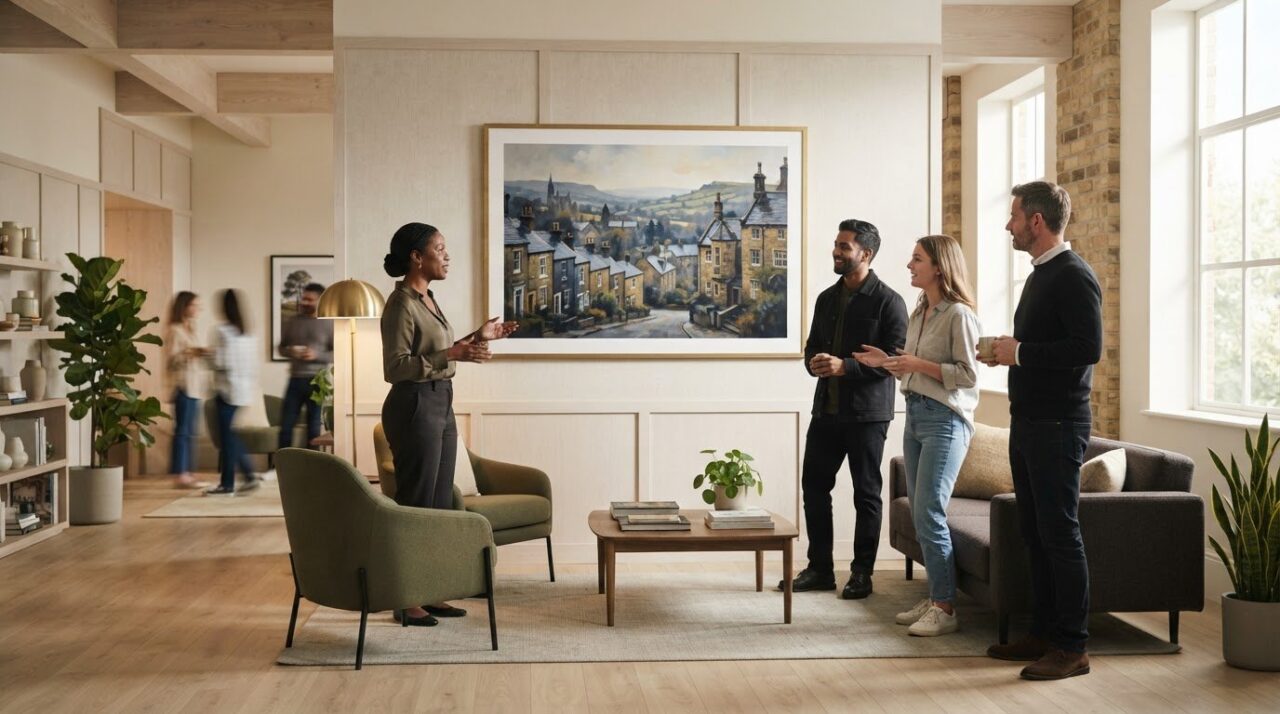
What if the artwork that starts a conversation also helps the office feel more welcoming, without distracting from the work? Choosing conversation starter artwork for office spaces means balancing visual interest with the room’s purpose, the organisation’s character and the people who use it.
A striking subject can feel out of place, while a small piece may be lost on a large wall. The right choice does not need to dominate. Thoughtful subject matter, scale and placement can create a focal point and give colleagues and visitors a natural reason to pause and talk.
This guide explains how to choose artwork that feels engaging yet appropriate for a shared workplace. You’ll find practical ways to assess a room, involve the people who use it and decide whether an original painting, limited edition print or architectural commission best suits the setting.
Key Takeaways
- Choose a subject with enough visual interest to prompt a question, without making the space feel overly busy or informal.
- Consider how original paintings, limited edition prints and architectural commissions each bring a different kind of character to an office.
- Start with the room’s purpose and users, then assess wall dimensions, viewing distance, lighting and existing colours.
- Involve the people who use the space to help find conversation starter artwork for office settings that feels relevant to them.
- Match the artwork’s format and presentation to the brief, rather than assuming one option will suit every workplace.
Why choose conversation starter artwork for an office?
A considered piece of art gives a room a point of focus before anyone says a word. It may prompt a visitor to ask about a detail, give colleagues something to notice together or help a shared space feel less anonymous. The best conversation starter artwork for office spaces makes room for these small moments without taking over the room’s purpose.
Conversation starter artwork is a visual focal point that invites questions or shared observations, making comfortable, voluntary conversation feel natural. Conversation itself can take many forms, from a brief exchange to a longer discussion. The nature of conversation helps explain why a shared point of interest can be an easy way in. The artwork does not need to dictate what people say. It simply offers a place to begin.
In reception, art can make a first impression feel more thoughtful and give waiting visitors something to look at. In a meeting room, it can add warmth and character. In a shared office, it may help the space feel shaped around the people who use it. Its conversational value should support the room’s function, not compete with clear signs, focused work or a meeting’s agenda.
What makes artwork easy to talk about?
A distinctive subject, recognisable detail or intriguing viewpoint can prompt a simple opening question: “What do you notice in this?” or “Does that remind you of somewhere?” A work does not need to be loud or provocative to hold attention. Often, a quieter image with layers to discover gives people more comfortable ways to respond.
There is no need for everyone to agree on what a work means. One colleague may be drawn to its colours, while another notices its composition or recalls a personal experience. That variety is part of the appeal. A useful focal point leaves space for different reactions rather than insisting on a single interpretation or putting anyone on the spot.
Which office spaces benefit most from a visual focal point?
Think about who enters each room and the conversations they are likely to have. Reception serves visitors as well as staff, so artwork can create a welcoming pause and offer an easy subject for a brief exchange. In a meeting room, a work can soften a formal setting and provide a shared point of attention during a natural break.
Informal shared spaces, such as a kitchen or breakout area, often suit artwork that rewards a closer look, since people may have time to linger. A focused work area may benefit from a calmer image with less visual activity, adding character without repeatedly drawing the eye away from tasks. Consider the room’s purpose, how people move through it and whether conversation is welcome, occasional or best kept to breaks. The right choice feels part of the workplace, not an interruption.
What makes office artwork engaging without becoming distracting?
Engaging artwork does not have to be loud, controversial or informal. A strong choice often has a clear visual idea, then leaves the viewer room to look a little longer. Suitable office art should attract attention briefly without competing with the room’s purpose. That balance depends on the work itself and where people encounter it.
Subject, contrast, scale and detail all shape a first impression. A bold outline may be noticeable from across reception, while finer details reward someone sitting nearby. High contrast can make a work feel more immediate; softer tonal shifts may create a calmer impression. A large piece can anchor a spacious wall, but if it dominates a small meeting room, it may become the main event rather than a considered part of the setting.
Think of visual impact as a relationship between the artwork and its surroundings. Consider viewing distance, the pace of activity in the room and the colours already present in furnishings, flooring and signage. For a wider perspective on how art can contribute to shared work environments, see Impact of art on workplace well-being and productivity. The practical aim is not to maximise attention, but to choose work that feels welcome in its setting.
How should subject and colour support the room?
Architectural subjects can bring structure and a sense of place; landscapes may introduce openness or a quieter mood; portraits can add a human presence. None guarantees a particular reaction, so consider which subject feels fitting for the room and its users. Restrained colours may sit gently among existing finishes, while vivid notes can bring energy. Neither approach suits every office. View the artwork alongside the furnishings and in the room’s natural and artificial light. Then consider whether its character supports the atmosphere you want to create.
How can you balance interest with a professional atmosphere?
Distinctive does not have to mean provocative. Thoughtful composition, an unusual viewpoint or a detail that reveals itself gradually can make a work memorable without relying on humour that might not suit every colleague, client or visitor. Picture the full range of people who will see it, not only those choosing it. A considered subject gives people something to respond to while remaining comfortable in a shared workplace.
Placement matters, too. Put the strongest visual statement where people can pause naturally, such as a reception waiting area or near a meeting room entrance. Avoid placing it beside a busy route, a sign people need to read or a screen that already holds attention. In a quieter work zone, choose an image with fewer competing details. This lets the artwork contribute character without repeatedly pulling focus from tasks.
If you are weighing up a particular piece, view it in the context of the room rather than in isolation. Explore original paintings and limited edition prints as options for bringing considered visual interest into an office.
Original paintings, limited edition prints or a commission: which suits your office?
The right format depends on the space, the character you want to create and how closely the artwork needs to relate to the organisation. An original painting brings the presence of an individual work; a limited edition print presents an artist’s image in printed form; a commission can be shaped around a particular brief. Each can become conversation starter artwork for office spaces, but for different reasons.
Use this comparison to clarify what matters most before you choose:
| Format | Distinctiveness | Subject choice | How it may suit the brief |
|---|---|---|---|
| Original painting | An individual work with its own material presence and visual character. | Choose from the artist’s existing work. | Consider it when you want a singular focal point that suits the room’s atmosphere. |
| Limited edition print | A printed presentation of an artist’s image. | Choose from images available as prints. | May suit a brief centred on a particular image or a print format. |
| Architectural commission | Created in response to a tailored brief. | Can focus on a meaningful building or place. | Consider it when a connection to the organisation’s setting or story matters. |
When might an original painting or limited edition print work well?
An original painting is a one-off work, with physical qualities and details that can give a wall a distinct presence. It may be a natural fit if the office needs a considered centrepiece and you are drawn to a particular existing subject or composition. For more on choosing this format, explore the original paintings buying guide.
A limited edition print presents an artist’s image in printed form. It can suit a room when a particular image feels right and you prefer a print. The choice still comes down to how the image, scale and presentation work with the space. The limited edition fine art prints guide offers further advice on this format.
When could a commissioned artwork make the strongest connection?
A commission can respond to a building, a place that matters to the organisation or a shared story colleagues recognise. Architectural illustration is a commission option at Brian Crosby Art, making it worth considering when the building itself has meaning within the brief. A commission is not automatically more engaging than an existing work; its value lies in the personal relevance it can bring. For related insight into bespoke architectural artwork, see the commissioned house portraits guide.
As you compare options, ask what the artwork needs to do: add individual character, bring a chosen image into the space or reflect a particular place. A clear answer helps you select a format that feels appropriate, rather than assuming one is best for every office.

How to choose the right conversation starter artwork for your office
A little preparation makes it easier to compare artworks on more than first impressions. Start with the room and the people who use it, then check how a piece will look and function in its intended position. Use this sequence: purpose, placement, visual character and format.
- Define the room’s purpose and users. Note whether it is mainly for focused work, meetings, informal breaks or welcoming visitors. Consider who will see the artwork regularly and what atmosphere would feel appropriate to them.
- Choose a possible position. Identify a wall people can see naturally, without blocking signs, screens, doors or a clear route through the room. Consider whether viewers will pass by, sit facing it or have a chance to pause.
- Measure the wall and viewing distance. Record the available width and height, allowing for nearby furniture and fittings. Think about how far away people will usually be. A piece with delicate detail may be better suited to a place where viewers can approach it than to a wall seen from across a busy room.
- Check the light and existing colours. Notice daylight at different times, along with the effect of ceiling lights or desk lamps. Look for glare on the intended wall, and compare the artwork’s colours with furnishings and finishes so the overall effect feels considered.
- Gather a few reactions, then settle the brief. Invite regular users to share what they notice or how a shortlist feels in the room. Their responses can reveal different preferences, but everyone does not need to agree on one interpretation. Use the room’s needs to guide the final choice.
What should you assess before choosing a piece?
Look beyond the bare wall. Furniture, doors, screens and circulation routes all affect how much space the artwork has and whether it will be easy to see. Observe the room at different times of day, since natural and artificial light can change how colours appear or create distracting glare. Above all, match your assessment to the main activity and the people who encounter the work.
How do framing and placement affect the finished result?
A frame can help an artwork sit comfortably alongside the room’s finishes, while a strong contrast may give it a more defined presence. View the framed work in relation to nearby furniture and wall colours, rather than judging the image alone. Place it at a natural viewing height for people standing or seated, and keep sightlines to screens, signs and walkways clear. Creative framing guidance offers further presentation considerations.
Once you have a clear sense of the room, its users and the desired atmosphere, you can compare formats with greater confidence. Explore original paintings, limited edition prints and architectural commissions as options for finding a piece that feels at home in your office.
Finding office artwork with character through Brian Crosby Art
The most fitting artwork begins with a clear sense of the room: what happens there, who uses it and how you want it to feel. A welcoming reception may call for a different mood from a focused work area or a room where colleagues gather. With those needs in mind, it becomes easier to compare original paintings, limited edition prints and architectural commissions as different ways to bring character into the workplace.
Brian Crosby Art offers all three. An original painting brings the presence of an individual work; a limited edition print presents an artist’s image in printed form; an architectural commission can respond to a building or place that holds meaning for the organisation. No format is automatically the right choice. The best fit is the one that connects with the brief and feels comfortable in its surroundings.
Brian Crosby is a recognised member of the Society of Architectural Illustrators, bringing relevant experience to architectural illustration. For an office with a meaningful building or setting, that background may be particularly relevant when considering a commission. A work’s subject, composition and handling all contribute to its character, shaping whether it feels calm, lively, formal or personal without needing to make an exaggerated statement.
How can an artist-led approach help shape the choice?
An artist-led perspective can help you look beyond subject alone. The way a scene is composed, the details that draw the eye and the balance of colour all influence how a work sits in a room. Architectural illustration offers a considered route for organisations drawn to a particular building or place. That connection can make the artwork relevant to its setting, while leaving room for viewers to bring their own responses.
What details help define an office artwork brief?
A short, practical brief gives the decision a useful starting point. Note the room’s purpose, the people who use it, the intended wall and the atmosphere you hope to create. Add the preferred subject, approximate wall dimensions, existing colours and any interior details that should sit comfortably alongside the artwork. You do not need to settle every detail straight away; a few clear observations can help shape a more focused discussion.
These notes also help distinguish between choosing an existing work and exploring a bespoke commission. If the organisation wants art connected to a particular building or shared story, describe what makes that connection meaningful. If the priority is simply to find a work that complements the room, note the mood and visual character you have in mind.
Finding conversation starter artwork for office spaces is ultimately about bringing the artwork and its setting into thoughtful alignment. Explore Brian Crosby Art’s original paintings, limited edition prints and commissions, or discuss an architectural commission for your workplace.
Give your office a focal point with meaning
Start with one wall and the feeling you would like it to create. A calm pause in a shared space, a welcoming first impression or a detail that reflects the organisation’s story can all help shape your brief. From there, consider what colleagues and visitors might notice, and whether an existing work or a tailored piece feels like the better fit.
Brian Crosby Art offers original paintings, limited edition prints and architectural commissions. Brian Crosby’s recognised membership of the Society of Architectural Illustrators also brings a relevant perspective to architectural work. The aim is to find artwork that belongs in the room and gives people a natural reason to look twice, without demanding their attention.
Let the room’s character guide your next step. Explore Brian Crosby Art’s original paintings, limited edition prints and commissions to find a thoughtful focal point and consider the story you’d like your office artwork to tell.
Frequently Asked Questions
What makes artwork a conversation starter in an office?
Artwork can prompt conversation when it gives people a detail to notice or a question to ask. A distinctive viewpoint, recognisable feature or unexpected composition may catch someone’s eye, but viewers can respond differently without settling on one meaning. That is more inviting than choosing a piece simply to shock. For conversation starter artwork for office spaces, consider whether its subject feels comfortable for the colleagues, clients and visitors who will see it.
Can office artwork be interesting without distracting employees?
Yes. Interest can come from a subtle detail or thoughtful composition, not only intense colour, large scale or provocative subject matter. Think about how long people spend in the room and how close they are to the work. A meeting room may suit a more noticeable focal point, while a desk area used for concentrated tasks may call for less visual complexity. The goal is a considered atmosphere, not a promised productivity effect.
How do you choose artwork for a shared office?
Begin by considering who uses the space and what they need from it. For example, a team choosing artwork for a shared break area might each name a subject or mood they would welcome, then compare a small shortlist. Their comments can surface useful differences without requiring unanimous agreement. Check that the preferred piece feels at ease with the room’s furnishings and everyday use, so it feels like part of a shared setting rather than one person’s private taste.
Is an original painting or a limited edition print better for an office?
Neither is automatically better; each offers a different way to bring an image into a workplace. An original painting is an individual work, while a limited edition print presents an image in printed form. If the brief centres on the presence of a unique work, an original may appeal. If a particular image is the priority, a print may suit. Compare the options in the context of the room and the character you want it to have.
How large should artwork be for an office wall?
There is no single ideal size, because a wall’s shape and surroundings affect how a work will read. Measure the usable area, allowing for shelving, furniture and fittings, then consider where people will view it from. A simple way to test proportion is to mark out a candidate size on the wall with removable paper. Check that the outline does not intrude on doorways, screens or sightlines before making a decision.
Can commissioned artwork work as a conversation piece in an office?
Yes. A commission may suit an organisation that wants a work connected to a building, place or shared story. Architectural illustration is a relevant commission category at Brian Crosby Art. A brief might identify what makes the place meaningful and what atmosphere the artwork should convey. That personal connection can give people a subject to discuss, while leaving each viewer free to respond in their own way.