


You’ve just found a tattered envelope at the bottom of a dusty trunk, and inside is the only surviving photograph of your great-grandparents. As you hold it to the light, you notice a deep crease running through a familiar face whilst the once-vibrant colours are beginning to ghost away. It’s a common worry; the fear that these fragile links to our past might vanish before we can share them with our children. You may have tried a few mobile apps only to find the results look plastic or artificial, leaving you more frustrated than when you started.
True professional image restoration isn’t about clicking a button; it’s about a skilled artist carefully mending every pixel with a deep understanding of light and character. You’ll discover how professional artistry breathes new life into faded memories, ensuring your most precious photographs are preserved for generations to come. We will walk through the journey from a damaged original to a beautiful, display-ready print, explaining technical terms like archival quality and high-resolution scans in plain, friendly language.
Key Takeaways
- Learn the difference between simple retouching and professional image restoration, where digital precision meets an artist’s intuition to save your family heritage.
- Discover why an artist’s understanding of structure and light is vital for recreating lost details in a way that looks completely natural rather than artificial.
- Get practical advice on how to organise and prepare your physical photo collection for a safe, non-destructive scanning process.
- Understand the role of archival paper and bespoke framing in transforming a restored memory into a lasting gallery piece for your home.
What is Professional Image Restoration?
At its heart, professional image restoration is a delicate marriage between modern digital precision and the timeless intuition of a fine artist. It goes far beyond simply removing a few scratches or adjusting the brightness of a file. It’s about understanding the “soul” of a photograph; the subtle play of light on a grandmother’s lace collar or the specific grain of a 1940s film stock. Whilst basic photo retouching might focus on making a contemporary portrait look “perfect” by smoothing skin or whitening teeth, heritage restoration seeks a deeper truth. We aim to return a photograph to its original glory without stripping away the character that makes it a piece of your family history.
Preserving these items is an act of care for future generations. It ensures that the stories of those who came before us aren’t just told, but seen and felt through vivid, tangible imagery. A professional brings an architectural understanding of perspective and a teacher’s eye for colour to every project. This ensures that even when a significant portion of an image is missing, the reconstruction feels historically accurate and aesthetically pleasing rather than a modern, artificial guess.
The Difference Between DIY Filters and Professional Artistry
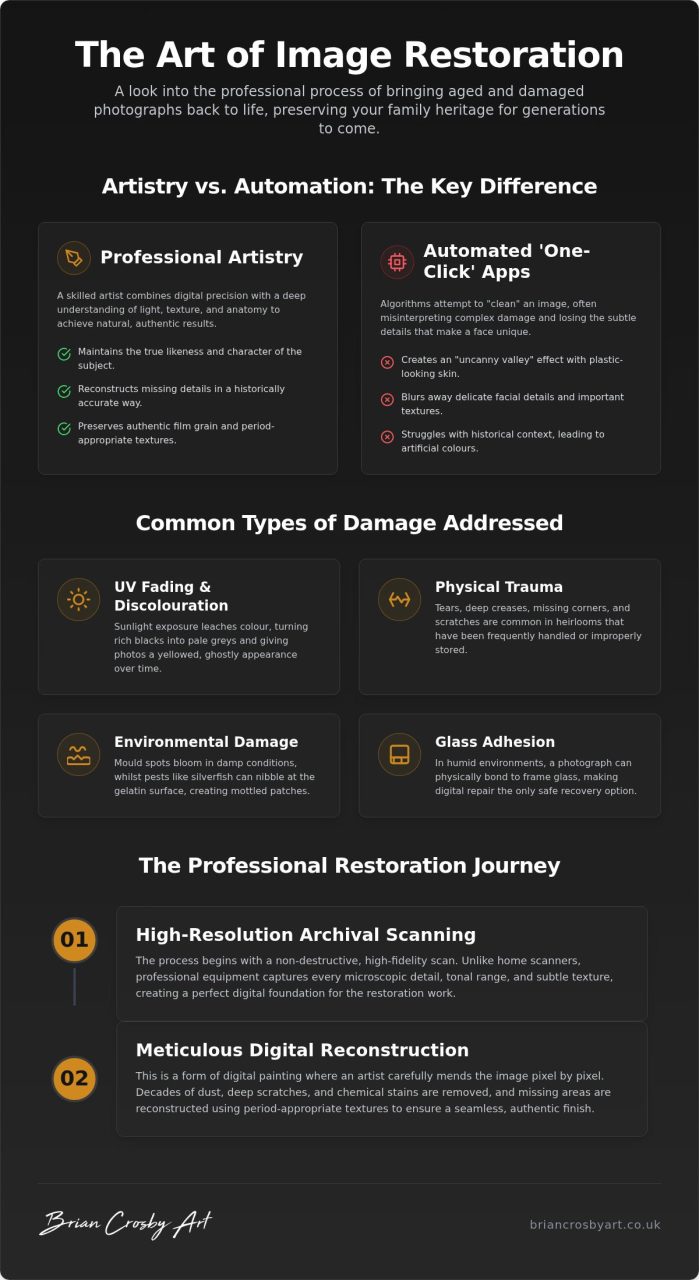
It’s tempting to use automated “one-click” apps found on smartphones. However, these tools often struggle with the nuances of human anatomy and historical context. They can lead to the “uncanny valley” effect, where faces look strangely plastic or over-saturated. A professional artist understands how to mend a tear through a cheekbone without losing the person’s likeness. We work to maintain the authentic texture of the era, respecting the original photographer’s intent. This manual approach prevents the loss of delicate facial details that algorithms frequently blur away in their attempt to “clean” the file.
Common Types of Photograph Damage We Can Address
Photographs are surprisingly fragile objects. Over decades, they face various environmental threats that can obscure your precious memories. Through Digital photograph restoration, we can tackle several specific issues that might seem terminal to the untrained eye:
- UV Fading and Discolouration: Exposure to sunlight often leaches the depth from an image, turning rich blacks into pale greys or giving the whole piece a yellowed, ghostly appearance.
- Physical Trauma: Tears, deep creases, and corner losses are common in family heirlooms that have been handled frequently or stored loosely in boxes.
- Biological and Environmental Damage: Silverfish often nibble at the gelatin surface of old prints, whilst mould spots can bloom in damp conditions, creating dark, mottled patches.
- Glass Adhesion: In humid environments, a photograph can physically bond to the glass of its frame. Attempting to peel it back usually destroys the original, making professional scanning and digital repair the only safe option.
By identifying these issues early, we can stop the decay and begin the process of reviving the image. Every professional image restoration project begins with a careful assessment of these factors to determine the best path forward for your specific heirloom.
The Artistic Process: How Old Memories Are Revived
The journey of professional image restoration is a patient and methodical one. It begins with the safe handling of your physical heirloom, ensuring the original remains entirely untouched whilst we create a digital twin for repair. This non-destructive approach means your precious photograph never leaves its physical state; instead, we work on a high-fidelity virtual canvas to mend the passage of time. It’s a transition from a fragile object to a vibrant, stable digital file that can be shared and printed for decades to come.
Step 1: High-Resolution Archival Scanning
Most home scanners are designed for simple documents and often fail to capture the subtle depth or tonal range hidden within old photographic chemistry. They can flatten textures and miss the fine silver grain that gives an image its character. We use professional archival scanning to document every microscopic detail before the editing process begins. This ensures we have the highest quality foundation possible. Fragile originals are handled with white-glove care, protecting them from unnecessary light exposure or physical stress throughout the digitisation phase.
Step 2: Digital Reconstruction and Repair
Once the scan is secured, the meticulous work of digital repair begins. This involves far more than just cleaning a file; it’s a form of digital painting. We carefully remove decades of dust, deep scratches, and chemical stains that have obscured the subject. If a corner is missing or an edge is torn, we use period-appropriate textures to fill the gaps seamlessly. Digital reconstruction is the manual rebuilding of image data. By focusing on the structural integrity of faces and backgrounds, we ensure the final result feels whole and authentic to the eye.
Step 3: Colour Correction and Atmospheric Balancing
The final stage of the digital work involves restoring the original mood and “temperature” of the photograph. We don’t just add colour; we balance the atmosphere. This might mean returning the rich warmth to a fading sepia print or restoring the striking crispness to a black and white portrait. My background in traditional portrait painting commissions allows me to apply classical colour theory to these digital files. This ensures that skin tones look natural and lifelike, avoiding the flat, artificial look often produced by automated tools.
The process concludes with the creation of a beautiful final piece, often using archival-grade inks and papers to ensure longevity. If you have a box of memories waiting for a new lease of life, you can explore our image restoration services to see how we can help you preserve your family history.
Artistry vs. Automation: Why an Artist’s Eye Matters
You might wonder if a free mobile app or a quick online filter could do the job just as well. It’s a fair question in an age where automated tools are everywhere. However, there’s a significant difference between an algorithm guessing at a face and a trained artist understanding it. Automated tools often rely on “averaging” pixels, which frequently results in a plastic, smoothed-over look that robs a person of their unique character. True professional image restoration is a form of digital portraiture; it requires a deep appreciation for the human form that no computer can truly replicate.
When you choose a professional, you’re hiring someone who understands how light interacts with skin, fabric, and surroundings. We don’t just “fix” a photo; we interpret the original photographer’s intent. This artistic intuition ensures the final result feels like a genuine memory rather than a modern, artificial recreation. It’s about preserving the “soul” of the image whilst removing the damage that obscures it.
The Society of Architectural Illustrators Standard
Structure is the foundation of every good image. As a member of the Society of Architectural Illustrators (SAI), I bring a specific set of skills to the restoration table. This professional recognition means I’m trained to understand perspective, vanishing points, and the way buildings are constructed. This knowledge is invaluable when restoring old heritage photos of family homes or historic streets. If a porch is missing or a roofline is blurred, I can use my experience as a professional house illustrator to rebuild those elements with structural accuracy. We ensure the geometry of the past is respected and correctly represented in your restored print.
Understanding Anatomy and Light
Computers are excellent at identifying patterns, but they don’t understand anatomy. If a crease runs right through a subject’s eye or jawline, an AI tool might create a distorted, “uncanny” version of that feature. A trained artist can “see” what’s missing by understanding the underlying bone structure and the way shadows naturally fall across a face. This allows us to maintain the subtle character in a person’s expression; that specific twinkle in an eye or the unique curve of a smile. By manually rebuilding these delicate areas, we ensure the person in the photograph still looks exactly like the loved one you remember, rather than a generic digital approximation.
Choosing professional image restoration means you value the tiny details that make your family history unique. It’s a patient, human-led process that treats your memories with the same respect and care that went into creating them decades ago.
Preparing Your Collection for Professional Restoration
Deciding to begin a professional image restoration project is a significant step in safeguarding your family history. It’s helpful to approach your collection with a plan to ensure the best results. Before you pack away your memories, take a moment to evaluate which pieces will benefit most from artistic attention. Think about the stories you want to tell and the faces you want future generations to recognise.
Choosing the Right Images for Restoration
Not every photograph requires the same level of care. Prioritise unique family heirlooms; those one-of-a-kind shots that capture a specific person or event; over mass-produced prints. When evaluating a faded photo, look for “information”. Even if a face looks pale or washed out, a professional can often pull out hidden details that aren’t visible to the naked eye. However, if a face is entirely missing or the damage is too severe for a digital fix, you might consider a custom portrait painting from photo. This allows us to use other references to recreate a likeness that a digital scan simply cannot find.
Safe Handling and Transportation Tips
Handling heritage items requires a gentle touch. It’s vital that you never attempt to “clean” an old photo with water, household chemicals, or even a damp cloth at home. These can cause the emulsion to lift or trigger a chemical reaction that destroys the image permanently. Whilst we perform digital repairs, we don’t offer physical chemical restoration of the paper itself; our goal is to capture a perfect scan and mend the digital version to keep the original safe from further harm.
When you’re ready to send your collection, use acid-free sleeves to protect the surface of each print. Place them between two pieces of stiff cardboard and use a padded, stiff-backed envelope for transit. This prevents bending or further cracking of the brittle paper. Organising your collection into chronological order or family groups can also help us understand the narrative. It makes the process smoother and ensures we focus on the details that matter most to your lineage. Taking these small steps protects your originals and gives us the best possible starting point. If you’re unsure which photos are suitable, you can contact us for a restoration assessment to discuss your collection. For those dealing with damp or flood-affected prints, our detailed guide on restoring water damaged photos UK families have trusted us with explains the safest approach to rescuing these particularly fragile heirlooms.
Bespoke Restoration and Framing: The Final Presentation
The digital file is only half the story. The true joy of professional image restoration comes when a memory moves from a hidden shoebox to a place of honour on your wall. This transition is where technical work meets fine art display. Selecting the right paper is a vital part of the journey. We use archival-grade papers that don’t just look beautiful but are designed to resist fading for many decades. These materials capture the depth of the blacks and the subtlety of the highlights, ensuring the new print feels like a premium piece of art rather than a standard photocopy. The tactile quality of a well-printed photograph adds a layer of reality that a screen simply cannot provide. For those who wish to expand their home collection further, exploring limited edition fine art prints is a wonderful way to complement a restored family heirloom with investment-worthy works that share the same archival quality standards.
The Role of Creative Framing
A restored photograph deserves a home that reflects its significance. Whilst shop-bought frames are convenient, they often lack the character and protective qualities required for heritage items. Creative framing services Gloucestershire specialists offer involves selecting mounts and mouldings that complement the specific era of your photograph. For instance, a Victorian portrait might look stunning in a deep, dark wood frame, whereas a mid-century snapshot might suit a cleaner, more minimalist profile. Beyond aesthetics, bespoke framing creates a controlled environment. It uses acid-free materials to prevent discolouration and ensures the print doesn’t touch the glass, protecting it from moisture and temperature shifts. If you’d like to learn more about the complete journey from digital repair to display, our guide on how to restore and frame old photos UK families treasure covers every stage in detail.
Starting Your Project with Brian Crosby Art
Every family history is unique, and the restoration process should be too. It begins with a personal consultation where we discuss the emotional weight of your collection and your desired outcome. As a friendly mentor in the creative process, I aim to make these technical decisions feel simple and supportive. This approach ensures you feel confident about the safety of your originals whilst they are in my care. Some clients choose to combine professional image restoration with other services; perhaps pairing a restored family photo with one of my architectural commissions of a childhood home. This creates a powerful, cohesive story of your heritage that spans both people and places.
These restored pieces make extraordinary gifts for landmark birthdays or anniversaries. There’s something deeply moving about seeing a parent’s wedding photo or a grandparent’s childhood home brought back to life in vivid detail. It’s a gift that grows in value as it’s passed down through the family. If you’re ready to preserve your legacy, I’m here to guide you through every step of the process. We’ll work together to ensure your most precious photographs are preserved for generations to come.
Contact Brian Crosby to discuss your professional image restoration project today.
Give Your Memories the Future They Deserve
Preserving your heritage is a journey that requires more than just software; it needs a human touch. By choosing professional image restoration, you ensure that every crease and fade is mended with a deep understanding of light, anatomy, and historical context. Whether it’s a tattered portrait or a fading architectural scene, my experience as a member of the Society of Architectural Illustrators and a qualified art teacher allows me to rebuild what time has stolen with precision and care.
We’ve explored how a bespoke, artist-led approach transforms a fragile print into a display-ready masterpiece. From high-resolution scanning to the final choice of archival paper, every step is designed to protect your original whilst creating a lasting legacy for your family to enjoy. Don’t let your most precious moments stay hidden in the dark or slowly ghost away.
Enquire about your professional image restoration project today to begin the revival of your family collection. It’s a privilege to help you share these stories once again and I look forward to seeing the history you want to preserve.
Frequently Asked Questions
How much does professional image restoration cost in the UK?
The cost of professional image restoration varies depending on the severity of the damage and the time required for manual rebuilding. We assess each photograph individually to provide a bespoke quote based on the complexity of the repair work. Factors such as deep tears through facial features or extreme UV fading require more intensive artistic attention than simple dust removal. This ensures you only pay for the specific level of care your family heirloom needs.
Can a very faded photograph really be restored to its original colour?
Yes, even significantly faded photographs can often be restored to their original vibrancy. By using advanced digital techniques and a trained artist’s understanding of colour theory, we can pull hidden information from the remaining silver grains in the print. Whilst some guesswork is involved if a photo is almost white, we use historical references and skin tone knowledge to ensure the final result looks natural and period-accurate rather than artificial.
Will the original photograph be damaged during the restoration process?
Your original photograph remains entirely safe and untouched throughout the entire process. We use a non-destructive approach, creating a high-resolution digital scan as the very first step. All restoration work is performed on this digital copy, meaning the physical heirloom is never subjected to chemicals or physical alterations. Once the scan is complete, your original is carefully stored until it’s ready to be returned to you along with the new work.
How long does it typically take to restore a damaged family photo?
Most professional image restoration projects are completed within two to four weeks, though this can vary based on the current studio schedule and the complexity of the work. Heavily damaged images that require meticulous digital painting may take longer to ensure every detail is perfect. We prioritise quality over speed to ensure your family history is preserved correctly. We’ll always provide a clear estimate of the expected turnaround time during your initial consultation.
What is the best way to send my fragile photos to you securely?
We recommend using a stiff-backed envelope and placing your photographs between two pieces of thick, acid-free cardboard to prevent bending. It’s best to use a tracked and insured postal service for peace of mind. For particularly fragile or valuable items, wrapping them in acid-free tissue paper before securing them between the cardboard provides an extra layer of protection against surface abrasions. We’ll notify you as soon as your collection arrives safely at our studio.
Do you provide a digital copy as well as a physical print?
Every project includes a high-resolution digital file as well as the option for a professional physical print. Providing a digital copy allows you to share the restored memory with family members across the globe and keeps a permanent backup safe for the future. We can also provide archival-quality prints on fine art paper, which are specifically designed to resist fading and discolouration for many decades when displayed correctly in your home gallery.
Can you remove people or objects from a photograph during restoration?
We can certainly remove unwanted elements, such as distracting background objects or photobombers, as part of the restoration process. This is often requested to bring the focus back to the primary subject of a historical portrait. Because this work is done by a trained artist rather than an automated tool, the “hole” left behind is manually rebuilt to match the surrounding textures and lighting, ensuring the final image looks completely seamless and natural.
What makes a “fine art” restoration different from a high-street service?
Fine art restoration relies on the expertise of a qualified artist who understands anatomy, perspective, and light. High-street services often use automated software that can result in a plastic, over-smoothed appearance. As a member of the Society of Architectural Illustrators, I bring a structural precision to every project. This ensures that faces look lifelike and buildings look architecturally correct, preserving the original character of the photograph rather than just “cleaning” the file. For those seeking a complete solution, our dedicated service to restore and frame old photos for UK heritage preservation combines fine art restoration with bespoke framing to create a truly finished heirloom. If you’re also interested in building a broader art collection, our guide to limited edition fine art prints for collectors explains how to identify archival quality works that will retain their beauty and value for decades.
[…] physically damaged. This is where the creative process becomes even more meaningful. By integrating professional image restoration techniques, an artist can repair cracks or sharpen blurry details before the first brushstroke even […]
[…] texture seamlessly. If you have an album containing cracked or fragmented prints, exploring bespoke professional image restoration will show you how manual artistry rebuilds lost details while leaving the original print completely […]
[…] For more guidance on caring for a damaged print, read this professional image restoration guide. […]