


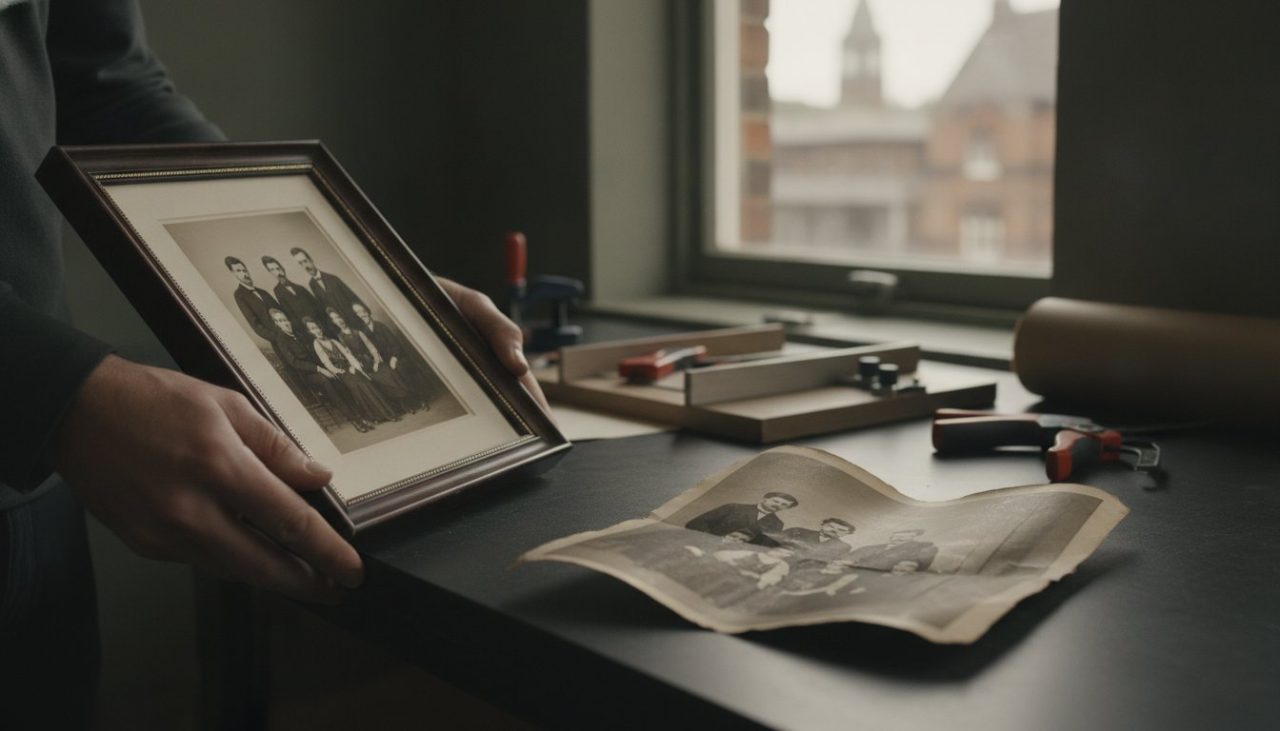
Imagine discovering a forgotten envelope tucked away in an attic, only to find the faces of your ancestors blurred by time and the delicate paper beginning to fray. It’s a heavy feeling to realise that a one-of-a-kind connection to your heritage is slowly slipping away. You might feel torn between the cold, artificial look of automated AI fixes and the worry that a physical repair might cause more harm than good.
We understand that these aren’t just pictures; they’re the quiet threads of your family history. If you’ve been looking for the best way to restore and frame old photos UK services can provide, you’re in the right place. This article will guide you through the professional techniques used to breathe life back into faded memories, transforming them into crisp, vibrant pieces of art that feel authentic and true. We’ll walk you through the journey from digital restoration to creative framing, ensuring your heritage is preserved in a beautiful, physical form that your family will treasure for generations.
Key Takeaways
- Identify specific types of photographic deterioration, such as silver mirroring and ultraviolet fading, to understand the true restoration potential of your family archive.
- Learn why professional 600dpi scanning is the essential foundation when you choose to restore and frame old photos UK wide, ensuring every delicate detail is preserved.
- Discover how bespoke creative framing acts as both a protective shield and an artistic enhancement, far surpassing the quality of standard shop-bought frames.
- Master the principles of long-term preservation by identifying the ideal environments for your finished work whilst avoiding hazards like humidity and direct heat.
- Understand the benefit of an artist-led approach, where historical expertise is used to rebuild missing details for a finish that looks natural rather than artificial.
Assessing the Damage: Can You Fix Old Family Photos?
Professional image restoration is much more than a technical click of a button. It’s a patient, artistic process where we create a high-fidelity digital version of your physical photograph to serve as a canvas for repair. This approach ensures your original heirloom remains untouched and safe whilst we work to resolve years of wear. When you choose professional photograph conservation methods through a digital lens, you aren’t just fixing a picture; you’re commissioning a piece of art.
Many families hesitate because they believe a photo is too far gone. Perhaps a face is lost in a tear or a background building has faded into a white haze. This is where an artist’s eye becomes essential. By understanding historical details and architectural structures, we can “fill in the gaps” with sensitivity, ensuring the final result feels authentic rather than artificial. It’s this level of care that defines the best services to restore and frame old photos UK wide. We look past the damage to find the story hidden beneath the cracks.
Identifying Different Types of Photographic Decay
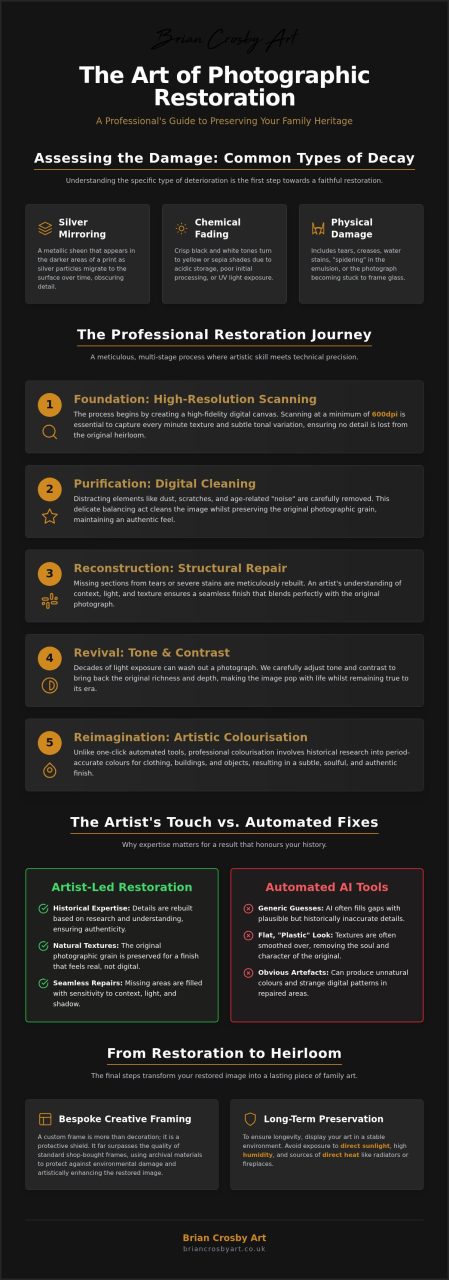
Photographic materials are surprisingly temperamental. You might notice “silver mirroring”, a strange metallic sheen that creeps across dark areas of a print as the silver grains migrate to the surface. Chemical fading is equally common, often turning crisp black and white memories into shades of yellow or sepia due to poor processing or acidic storage. Physical damage like “spidering” in the emulsion or deep water stains can be heartbreaking, but they are often just surface-level distractions. For families dealing with damp or flood-affected prints, specialist guidance on restoring water damaged photos UK artists provide can make the difference between saving and losing a treasured heirloom. One of the trickiest issues is when a photo has become stuck to the glass of its frame. In these cases, it’s vital to seek advice before attempting to peel it away, as the emulsion can easily tear and stay on the glass forever.
The Safe Handling of Original Heirlooms
Protecting your heritage starts with how you handle the originals. Never attempt to “clean” an old photo with household liquids, soaps, or even damp cloths, as these can trigger irreversible chemical reactions or soften the emulsion. We recommend using white cotton gloves and acid-free sleeves to prevent natural skin oils and salts from marking the delicate surface. Archival stability is the ability of a material to remain chemically inert over decades. By following these simple steps, you ensure the original survives alongside its new, restored counterpart. This dual approach is the gold standard for those who want to restore and frame old photos UK families can pass down with pride.
A Step-by-Step Guide to the Professional Restoration Process
Quality begins with a solid foundation. When you decide to restore and frame old photos UK families often find that the first step is the most critical. High-resolution scanning at a minimum of 600dpi is vital. This captures the minute textures of the paper and the subtle details of the emulsion that lower settings simply miss. We then move to digital cleaning. This isn’t about scrubbing away the history; it’s about removing distracting dust and age-related “noise” whilst carefully preserving the original photographic grain. This balance ensures the final print feels like an authentic photograph rather than a flat digital image.
Structural repair follows. This is where artistic skill meets technical precision. We rebuild missing sections, such as a torn corner or a scratched face, using the surrounding context to ensure a seamless finish. Finally, tone and contrast adjustments bring back the richness that decades of light exposure have leeched away. For those interested in the broader context of heritage, Museums Galleries Scotland provides excellent guidance on long-term care for photos.
The Art of Digital Colourisation
Many automated tools offer a “one-click” colour fix. These often result in a flat, artificial look that lacks soul. True colourisation is a patient study of history. We research period-accurate colours for clothing, military uniforms, and even building materials. This subtle palette breathes life into street scenes and brings out the character of family homes without ever looking “plastic”. It’s about adding warmth and depth whilst respecting the original era of the photograph.
Refining the Details: Retouching and Enhancement
The soul of a portrait lies in the eyes. We focus on sharpening these features to restore the original spirit of the subject. Distracting background elements that were not part of the photographer’s intent can be softened to keep the focus where it belongs. This meticulous attention to detail makes professional image restoration the gold standard for anyone looking to restore and frame old photos UK heritage pieces. It’s a journey of rediscovery that honours your past and prepares it for the future.
Bespoke Framing: Transforming Restored Photos into Gallery Art
A professional restoration shouldn’t end with a digital file on a hard drive. To truly honour a family legacy, the final image needs a physical home that matches its significance. Whilst high-street shops offer ready-made frames, these generic options often lack the character and archival quality required for a heritage piece. When you choose to restore and frame old photos UK services should treat the framing as an artistic extension of the restoration itself. A bespoke frame doesn’t just hold the picture; it elevates it into a piece of gallery art that commands attention in your home.
The psychological impact of seeing a once-faded, torn memory properly mounted and displayed is profound. It moves the image from a fragile relic hidden in a drawer to a celebrated part of your daily life. We carefully select frame styles that complement the specific era of your photograph. An ornate, dark wood moulding might suit a formal Victorian portrait, whilst a slim, minimalist profile better reflects the optimistic lines of the mid-century period. This attention to historical context ensures the frame feels like it belongs to the era of the subject.
Selecting the Right Mount and Moulding
Choosing a mount is about more than just aesthetics. It provides essential “breathing space” between the print surface and the glass, preventing the emulsion from sticking or moulding over time. We focus on colour-matching mounts to the specific tones of your restored work. A cool white might make a black and white photo look too stark, whereas a soft cream or charcoal can enhance the rich depth of a sepia-toned print. By coordinating these elements, you can create a cohesive “heritage gallery” on a single wall that tells your family’s story through the decades.
Creative Framing for Multi-Photo Displays
Sometimes the story is best told through comparison. Designing “before and after” frames allows you to showcase the remarkable restoration journey your heirloom has taken. For a truly comprehensive family narrative, consider combining a restored photo of an ancestor with a commissioned house portrait of the family home. This pairing creates a powerful visual history of both people and place. To ensure these works last for another century, we always recommend non-reflective, UV-protective glass. This specialised glazing shields the delicate pigments from sunlight and fluorescent glare whilst providing a crystal-clear view of every restored detail.
Preserving Your History: Long-term Care for Your Restored Art
Once you’ve taken the step to restore and frame old photos UK, you’ve essentially rescued a piece of history. However, the environment in which you place your finished art determines how long that history survives. Light, heat, and moisture are the primary enemies of any framed work. Direct sunlight can cause colours to fade even with UV-protective glass, whilst extreme temperature fluctuations can lead to the paper warping or the frame joints expanding.
Avoid the temptation to hang your restored pieces above a radiator or on a chimney breast. The rising heat creates a micro-climate that is far too dry for delicate paper. Similarly, bathrooms and kitchens are unsuitable due to high humidity levels that encourage mould growth. Whilst the physical print is now secure in its frame, don’t forget the digital heritage. We recommend keeping multiple backups of your restored file on separate devices or cloud storage. For your physical originals, organise them in acid-free envelopes and label them clearly with names and dates, ensuring future generations know exactly who they’re looking at.
Archival Standards for Printing and Mounting
To achieve a gallery-standard finish, we utilise Giclée printing. This method uses pigment-based inks rather than traditional dyes, offering a depth of colour and longevity that retail prints cannot match. When paired with acid-free mount boards, you eliminate the risk of “mount burn”, the unsightly yellowing that occurs when acidic materials leach into the paper. Archival framing ensures the artwork remains in pristine condition for over a century.
Displaying Your Restored Photos Safely
Placement is key to enjoying your collection. Aim for eye-level hanging, typically around 145cm to 150cm from the floor to the centre of the image. For lighting, indirect sources are best. Instead of pointing a spotlight directly at the glass, use ambient room light or “bounce” light off a nearby wall to highlight the textures of the frame and the clarity of the restoration. If you have a large collection, consider rotating which pieces are on display every few years. This reduces total light exposure and keeps your home gallery feeling fresh and engaging.
If you’re ready to begin your own preservation journey, explore our professional image restoration and creative framing services to see how we can help.
The Professional Difference: Why Artistic Expertise Matters
Choosing to restore and frame old photos UK wide often involves a choice between a quick, automated retail fix and a dedicated artistic commission. Whilst a high-street scan might offer speed, it often lacks the soul that only a human eye can capture. AI filters tend to over-process images, removing the very character that makes a face recognisable. An artist-led approach treats every scratch and fade as a puzzle to be solved with empathy. It’s about more than just pixels; it’s about a one-to-one connection between the person who values the memory and the craftsman who preserves it.
Human intuition is something a machine cannot replicate. An artist understands how light falls across a face or how a specific expression defines a personality. When we work on a portrait, we aren’t just “fixing” an image; we’re recovering a person’s spirit. This personal touch ensures that the final result feels like an authentic photograph from the era, rather than a flat, digital recreation. You’re involved in the process, ensuring the final piece reflects the history you remember.
The Society of Architectural Illustrators (SAI) Standards
Membership in the Society of Architectural Illustrators (SAI) brings a unique level of precision to heritage projects. When a photo of a family home from the 1920s is heavily damaged, an architectural background allows for the precise reconstruction of missing eaves, chimneys, or garden layouts. This isn’t guesswork; it’s an informed application of perspective and period detail. This architectural expertise is invaluable when you want to restore and frame old photos UK families have kept of their ancestral homes. This same level of craftsmanship is visible across my broader work, including original paintings for sale UK collectors often seek out for their atmospheric beauty.
From Restoration to New Commissions
The restoration process often sparks a deeper desire to honour a family member in a more permanent way. A crisp, restored digital image provides an excellent foundation for a traditional portrait painting. Moving from a damaged, monochrome heirloom to a hand-painted work in full colour is a profound transformation. It turns a historical record into a living piece of fine art that can be passed down for centuries. Taking that first step to save a piece of your history today ensures these stories aren’t lost to time, but are instead given a new life on your walls. It’s a journey of preservation that begins with a single, faded photograph and ends with a masterpiece.
Give Your Family History a Permanent Home
Professional restoration is more than a technical fix; it’s an act of preservation that honours the people who came before us. By combining high-resolution digital repair with archival printing, we can save even the most fragile heirlooms from being lost forever. You’ve seen how the right environment and artistic intuition can transform a damaged print back into a vibrant window to the past.
When you choose to restore and frame old photos UK heritage services, you’re ensuring those memories are both protected and beautifully displayed. As a member of the Society of Architectural Illustrators and a qualified art educator with over 20 years of experience, I treat every project with the precision and care it deserves. My bespoke creative framing service provides the essential final touch, turning a restored print into a piece of gallery-quality art that stands the test of time.
Enquire about professional restoration and framing for your family treasures today. It’s a wonderful feeling to see a faded memory return to its former glory, ready to be enjoyed by your children and grandchildren for decades to come.
Frequently Asked Questions
Is it possible to restore a photo that is torn into several pieces?
Yes, we can certainly restore photographs that have been torn into multiple pieces. We carefully scan each fragment individually and then use digital techniques to piece them back together like a complex jigsaw. As a member of the Society of Architectural Illustrators, I use my experience in structural reconstruction to rebuild missing edges or details. This ensures the final print looks seamless and avoids any visible joins from the original physical damage.
How much does professional photo restoration cost in the UK?
The cost to restore and frame old photos UK wide varies depending on the complexity of the damage and the level of artistic detail required. Factors such as missing facial features, heavy water damage, or intricate background reconstruction will influence the final quote. Every project is unique, so we provide bespoke pricing after reviewing your specific photograph. This ensures you receive a fair assessment based on the actual time and craftsmanship needed for your heirloom.
Will I get my original photograph back after the restoration process?
You will always receive your original photograph back safely. Our restoration process is entirely digital, meaning we scan your physical original and perform all repairs on a high-resolution copy. Once the scanning is complete, your original heirloom is returned to you untouched. We recommend keeping the original in an acid-free sleeve whilst displaying your new, restored, and beautifully framed version as the primary piece in your home gallery.
Can you colourise a black and white photo if I don’t know the original colours?
Yes, we can colourise photographs even if you don’t have records of the original colours. We use historical research and artistic intuition to select period-accurate shades for clothing, uniforms, and architectural materials. My background as an art educator helps me apply layers of colour that feel natural and atmospheric. We avoid the artificial look of automated filters, focusing instead on a subtle palette that respects the era of the original image.
What is the best way to scan my old photos at home for restoration?
If you’re scanning at home, use a dedicated flatbed scanner rather than a mobile phone camera. Set your resolution to at least 600dpi to capture every fine detail of the paper and emulsion. Save the file in a TIFF format to avoid the quality loss associated with JPEGs. Ensure the scanner glass is clean and free of dust. If you’re unsure about the process, we can handle the professional high-resolution scanning for you at the studio.
How long does the professional restoration and framing process typically take?
A typical project usually takes between two and four weeks to complete from the initial scan to the finished frame. This timeframe allows us to perform meticulous digital repairs and create a bespoke, hand-finished frame that perfectly suits the piece. Complex restorations or multi-photo heritage displays may take slightly longer. We always keep you informed of the progress, ensuring that the patient nature of the artistic process is never rushed for the sake of speed.
Can you remove people or objects from an old family photograph?
We can certainly remove distracting objects or individuals from your photographs to improve the overall composition. This is a common request when an accidental background element draws focus away from the main subject. We carefully rebuild the background using architectural and environmental details that match the original scene. This ensures the final image feels balanced and focused on the people or places that matter most to your family story.
What type of glass should I choose for framing a restored family heirloom?
We highly recommend choosing UV-protective, non-reflective glass for any restored heritage piece. This specialised glazing shields the delicate pigments from fading caused by sunlight and indoor lighting. It also reduces distracting glare, allowing you to see the fine details of the restoration from any angle in the room. This choice is an essential part of archival framing, ensuring your artwork remains in pristine condition for a century or more.
[…] like to learn more about the complete journey from digital repair to display, our guide on how to restore and frame old photos UK families treasure covers every stage in […]