

Did you know that just 45 minutes of sketching or painting can significantly lower your stress hormones, regardless of your artistic talent? Research from Drexel University confirms that creative expression is a powerful tool for wellness, which is why art lessons for beginners have become such a popular way to disconnect from the digital world. You might recognise that familiar hesitation when staring at a crisp blank page, or perhaps you feel a sense of confusion when faced with aisles of expensive materials you don’t yet know how to use.
It’s a common hurdle, but art is a skill of observation that anyone can learn with the right approach. In this guide, we’ll show you how to move from that initial uncertainty to a finished piece you’re proud to display. You’ll discover the essential materials you need to start your journey in 2026, alongside expert guidance on foundational techniques like colour theory and perspective. We’ll also explore how structured, friendly tuition can help you build confidence and turn a simple interest into a deeply rewarding hobby that brings a sense of tranquillity to your daily life.
Key Takeaways
- Discover how structured art lessons for beginners can demystify the creative process and help you confidently overcome the fear of the blank page.
- Learn the vital shift from drawing what you think you see to accurately observing the delicate interplay of light, atmosphere, and perspective.
- Compare the unique qualities of watercolour, oil, and graphite to find the most forgiving and rewarding medium for your personal creative goals.
- Understand how to organise an inviting, low-stress creative space at home with a streamlined starter kit that avoids unnecessary expense.
- Realise why personal mentorship from a qualified teacher helps you fix technical gaps quickly and build lasting artistic confidence.
Overcoming the Blank Page: What are Art Lessons for Beginners?
At its heart, visual arts education is about learning to speak a new language. Instead of using words and grammar, you learn to communicate through line, tone, and composition. For many, the greatest obstacle isn’t a lack of ideas, but the sheer intimidation of a pristine white canvas. Art lessons for beginners provide the structure needed to break through this paralysis. By following a guided path, you aren’t just doodling; you’re building a foundation of technical knowledge that allows your creativity to flourish. It’s about moving from “I can’t draw” to “I understand how to see.”
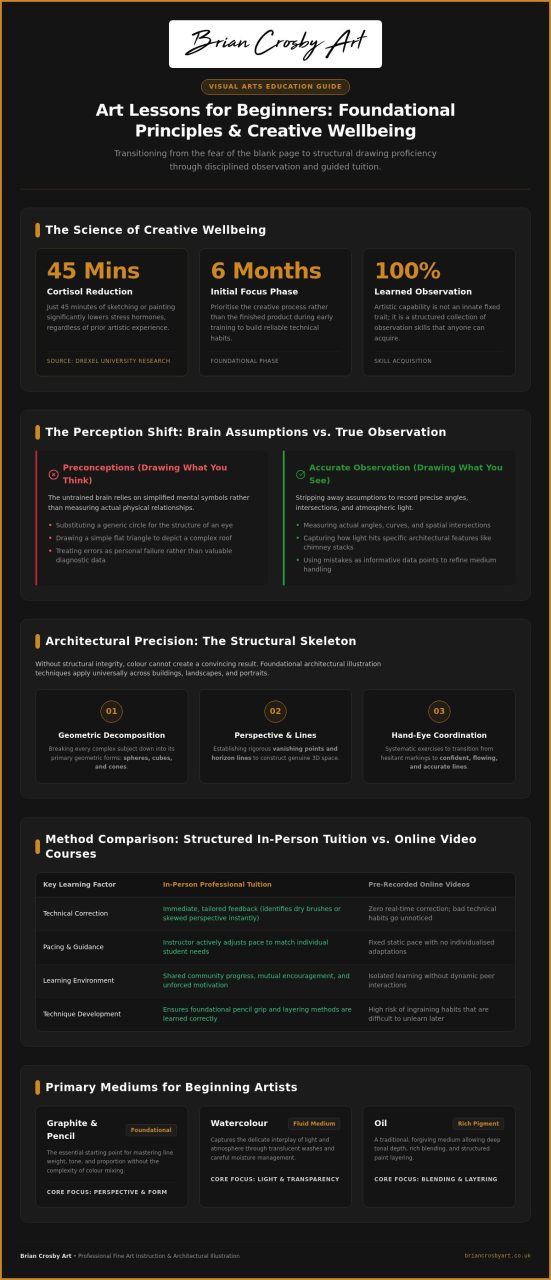
Working with a qualified mentor from the start ensures you don’t develop technical bad habits that can be difficult to unlearn later. Whether it’s the way you hold a pencil or how you layer paint, early guidance provides a shortcut to proficiency. There’s also a profound psychological shift. Immersing yourself in a creative task for just 45 minutes can lower cortisol levels, offering a meditative escape from the pressures of daily life. During your first six months, focus on the process rather than the product. You’ll likely move from basic geometric shapes to understanding the underlying structure of your subject. This structural approach, rooted in professional architectural illustration, ensures every piece you create has a solid, believable foundation.
The Myth of Natural Talent
We often hear people say they can’t draw a stick figure, as if artistic ability is a fixed trait you’re born with. It’s a myth. What we call talent is actually a collection of learned observation skills. Anyone can train their eye to see the specific shapes, light, and shadows that make up a landscape or a portrait. It requires patience and a growth mindset. In the studio, mistakes aren’t failures. Errors are lessons. They’re vital data points that help you understand your medium better and refine your technique over time.
In-Person Tuition vs. Online Video Courses
While the internet is full of tutorials, they lack the immediate, tailored feedback that a professional teacher provides. A video can’t see that your perspective is slightly skewed or that your brush is too dry. In a physical classroom, a qualified instructor adjusts the pace to suit your individual needs, offering encouragement exactly when you need it. There’s also the joy of community. Learning amongst fellow students creates a supportive atmosphere where you can share insights and celebrate each other’s progress. It’s a shared journey that makes the learning process feel natural and unforced.
Mastering the Essentials: Foundational Techniques for New Artists
Learning to draw is essentially learning to see. Most of us look at an object and our brain provides a simplified symbol of it; a circle for an eye or a triangle for a roof. True observation involves stripping away those assumptions to see the actual angles, curves, and intersections. During art lessons for beginners, we focus on this vital shift in perception. It’s the difference between drawing a generic house and capturing the specific way light hits a particular chimney stack. Mastering these foundational drawing techniques and materials allows you to record the world with newfound accuracy and quiet confidence.
Structure is the skeleton of any great work. Without it, even the most beautiful colours will feel unconvincing. By understanding the secrets of a professional house illustrator, you can learn to use vanishing points and horizon lines to create a believable sense of three-dimensional space. This architectural precision isn’t just for buildings. It applies to portraits and landscapes too, providing a sturdy framework for your creativity. If you’re looking for tailored support, you might find that art lessons for beginners through Brian Crosby Art offer the perfect environment to refine these skills at your own pace.
The Power of Line and Shape
Everything in nature can be broken down into spheres, cubes, and cones. By starting with these simple geometric forms, you can build up complex subjects without feeling overwhelmed. We use specific exercises to improve your hand-eye coordination, helping you move from hesitant marks to confident, flowing lines. These architectural principles ensure your proportions remain accurate from the very first sketch, allowing you to organise your favourite subjects within the frame effectively.
Understanding Light and Shadow
Value refers to how light or dark a colour is, and it’s the key to creating depth. Once you identify your primary light source, you can begin to map out where the shadows fall. This process transforms a flat, two-dimensional surface into a convincing three-dimensional form. Chiaroscuro is the contrast between light and dark to create drama. By balancing these tones, you bring a sense of atmosphere and weight to your work, making the subject feel truly present on the page.
Choosing Your Medium: Watercolour, Oil, or Pencil?
Selecting your first medium is a pivotal step in your creative development. It’s about finding a tool that resonates with your personality and the subjects you wish to capture. Whilst some beginners find comfort in the dry, controlled nature of graphite, others are drawn to the luminous, fluid qualities of paint. Engaging with any medium offers significant cognitive and mental health benefits of making art, including improved focus and a sense of quiet accomplishment. When starting art lessons for beginners, we often explore several options to see which one feels most natural to your style.
Graphite and ink serve as the bedrock of fine art. They provide the structural clarity required for traditional portrait painting commissions, where precision and tonal value are paramount. Mastering a pencil allows you to understand form without the added complexity of colour. Once you’re comfortable with these foundations, transitioning to paint feels like a natural progression rather than a daunting leap.
The Versatility of Watercolours
Watercolours are a favourite for architectural landscapes due to their portability and atmospheric transparency. To get the best results, you’ll need high-quality 140lb cold-press paper to prevent buckling when wet. During your art lessons for beginners, we use student-grade pans or tubes to teach you how to create soft, ethereal washes alongside sharp, architectural details. It’s a medium that rewards a light touch and a bit of forward planning, as you’re often working from light to dark.
The Depth of Oil Painting
Oil painting offers a richness of colour and depth that is hard to match. It’s surprisingly forgiving for new artists because the slow drying time allows you to layer, blend, and correct your work over several days. You’ll learn the “fat over lean” rule; this involves applying paint with higher oil content over layers with less oil to ensure the piece dries evenly without cracking. Blending colours directly on the canvas helps create realistic effects and smooth transitions in skin tones or skies. Safety is vital. Always check your materials for the ASTM D4236-26 standard to ensure they’re safely labelled. Using water-mixable oils or solvent-free mediums allows you to maintain a safe, organised workspace even in a small home studio.
Organising Your Creative Space and Mindset
Starting your creative journey doesn’t require a converted attic or a high-ceilinged studio. Most successful artists begin at a kitchen table or a small desk in the corner of a spare room. The key is to make your space inviting. If you have to spend twenty minutes digging brushes out of a cupboard, you’re less likely to start. Keeping a dedicated, friction-free setup allows you to dive into your practice whenever inspiration strikes. It’s about creating a sanctuary where you feel safe to experiment without judgment.
During our art lessons for beginners, we often discuss the “ugly stage” of a painting. This is the messy middle where the initial sketch is gone, but the final details haven’t yet brought the piece to life. It’s the point where many novices feel like giving up. Recognising this stage as a natural part of the process is vital for your growth. It isn’t a sign of failure; it’s simply a transition. Learning to push through this phase is what separates a finished masterpiece from a discarded canvas.
Essential Supplies for the Beginner
When you’re first starting, the temptation to buy a 50-piece brush set is strong. However, a few high-quality synthetic or natural hair brushes will serve you much better than a bucket of cheap ones that shed bristles onto your work. Focus on a versatile palette of primary colours. By learning to mix your own shades, you’ll avoid the “muddy” results that come from using too many pre-mixed tubes. Whether you choose 300gsm watercolour paper or a primed canvas board, ensure the surface is designed for your specific medium to avoid frustration.
Cultivating Artistic Confidence
Building a regular practice habit is more about consistency than duration. Even fifteen minutes of sketching whilst the kettle boils helps maintain your hand-eye coordination. Silencing your inner critic is perhaps the hardest part of art lessons for beginners. Try to view your sketchbook as a private laboratory for low-stakes experimentation rather than a gallery of finished works. Setting small, achievable goals, such as mastering a single shadow or a specific texture, ensures every session feels like a victory.
If you’re looking for a supportive environment to develop these habits, you might enjoy joining my art lessons for beginners for hands-on mentorship and steady progress.
Transitioning to Excellence: Why Professional Tuition Matters
While self-study has its place, the leap from a casual hobbyist to a confident artist often requires the discerning eye of a mentor. Art lessons for beginners provide more than just technical instructions; they offer a mirror to your progress. A qualified teacher can spot a subtle misalignment in perspective or a muddy colour mix before it becomes an ingrained habit. This level of professional art classes for adults accelerates your development by providing real-time corrections that a pre-recorded video simply cannot offer. It turns the often-lonely process of learning into a shared, encouraging experience.
As you grow, your focus shifts from simple mark-making to creating cohesive original paintings that tell a story. You’ll begin to understand the nuances of composition and the emotional weight of certain colour palettes. This transition marks the point where you might consider your first commission or even a local exhibition. Having an experienced guide helps you navigate these milestones with quiet confidence, ensuring your work meets a professional standard whilst retaining your personal touch. It’s about moving beyond the “how” of art and into the “why,” finding the character in every subject you choose to paint.
Personalised Learning Paths
Every artist has a different destination. Some are drawn to the rugged textures of a landscape, whilst others find beauty in the intricate details of a portrait. Small group settings allow for this level of individual attention, ensuring the curriculum bends to your interests rather than forcing you into a rigid box. A mentor doesn’t just teach you how to paint like them; they help you discover your unique artistic voice. This tailored approach ensures that your time in the studio is both productive and deeply fulfilling.
The Journey from Beginner to Improver
You’ll know you’re ready for the next stage when the basic rules of perspective and tone become second nature. This is the time to start building a portfolio that reflects your evolving style and technical range. It’s a rewarding process that turns a collection of sketches into a body of work. Recognising these signs of growth is a vital part of the artistic journey. If you’re ready to start, explore the friendly and supportive atmosphere of art lessons for beginners with Brian Crosby, where we focus on steady progress and the simple joy of the creative process.
Start Your Artistic Journey with Confidence
Embracing your creative side isn’t about an innate gift; it’s about learning to see the world through a structured lens of light, shadow, and perspective. By choosing the right medium and organising a simple, inviting space, you’ve already cleared the biggest hurdles to steady progress. Moving from a blank page to a finished piece is a journey best taken with a reliable guide who can help you avoid common pitfalls and find your unique voice. This structured approach ensures that every mark you make on the paper is a purposeful step toward excellence.
As a qualified art teacher and a member of the Society of Architectural Illustrators, Brian Crosby provides the expert guidance needed to turn your curiosity into a rewarding skill. These art lessons for beginners are held in a supportive, small-group environment where your individual progress is always the priority. You’ll find a community of like-minded learners who value personal growth and atmospheric beauty as much as you do. Enquire about art lessons for beginners with Brian Crosby today to begin your transformation from a hesitant starter to a confident creator. Your masterpiece is waiting to be discovered, one patient brushstroke at a time.
Frequently Asked Questions
Do I need to have any previous drawing experience to join a beginner class?
No previous experience is required to join a beginner class. These sessions are specifically designed for those who haven’t picked up a pencil since school. You’ll start with the very basics of mark-making and observation in a supportive environment. The goal of art lessons for beginners is to build your confidence from the ground up, ensuring you feel comfortable regardless of your starting point or previous background in creative subjects.
What basic art supplies should I buy before my first lesson?
It’s best to start with a simple, high-quality kit rather than a large set of cheap materials. For your first lesson, a small range of graphite pencils (from 2H to 6B), a kneaded eraser, and a spiral-bound A4 sketchbook are usually sufficient. If you’re moving into colour, a student-grade watercolour pan set or a few primary oil tubes will serve you well. Avoid overbuying until you’ve explored which medium resonates most with your personal style.
How long does it typically take to see progress in my painting skills?
You’ll likely notice a reduction in stress after just one session, whilst technical progress usually becomes visible within the first few months of regular practice. Most students find that their ability to observe shapes and proportions improves significantly after four to six lessons. By the six-month mark, you’ll typically have moved from simple geometric exercises to completing basic landscapes or portraits. Consistency is more important than the length of each individual practice session.
Is it better to start with drawing or should I go straight to painting?
Starting with drawing is generally recommended because it builds the essential foundations of perspective, structure, and value. These skills are the skeleton of any successful painting. However, many learners enjoy alternating between the two to keep their practice engaging. Understanding how to translate a three-dimensional subject onto a flat surface with a pencil makes the transition to using a brush much more intuitive and less overwhelming for a new artist.
Can I learn to paint if I think I have no natural artistic talent?
Absolutely, because artistic ability is a learned skill of observation rather than a mysterious, innate gift. Anyone can train their eye to see the specific angles, light, and shadows that make up a subject. Art lessons for beginners focus on demystifying the creative process by breaking it down into manageable, logical steps. With patient guidance and a growth mindset, you’ll find that what once seemed like talent is actually a set of techniques you can master.
What is the difference between beginner and improver art lessons?
Beginner lessons focus on the fundamental visual language, including basic line control, simple perspective, and introductory colour theory. Improver lessons are tailored for those who have mastered these basics and are ready to tackle more complex compositions or refined techniques. Whilst beginners work on building confidence, improvers often focus on developing their unique artistic voice and exploring more advanced mediums. It’s a natural progression that ensures you’re always challenged but never overwhelmed by the curriculum.
Are small group classes better than one-to-one art tuition?
Small group classes offer a wonderful sense of community and the opportunity to learn from the questions and progress of your peers. This social aspect often makes the learning process feel more relaxed and less pressured. One-to-one tuition provides more intensive, personalised feedback tailored specifically to your individual technical gaps. Both formats have their merits, but many find the supportive atmosphere of a small group is the perfect starting point for building initial confidence.
How do I choose between learning watercolours or oil painting?
Your choice depends on your preferred working style and environment. Watercolours are celebrated for their portability and atmospheric transparency, making them ideal for architectural landscapes or quick sketches. Oil painting offers a rich, tactile experience with a slow drying time that allows for easy blending and corrections over several days. If you prefer a medium that is forgiving and allows for layering, oils are excellent. If you value luminosity and zero toxic solvents, watercolours are a fantastic choice.