


The way the soft afternoon light catches the weathered brickwork of your chimney is a sight you know by heart, yet a standard photograph rarely captures that specific feeling of belonging. You might have searched for an artist before, only to struggle with the difference between a simple amateur sketch and a truly sophisticated piece of architectural art. It is a common worry that a drawing might look technically correct but lack the unique character that makes your house a home. Choosing a professional house illustrator ensures that every gable, window pane, and shadow is rendered with both structural accuracy and a deep sense of atmosphere.
You deserve an artwork that stands as a meaningful family heirloom rather than a fleeting digital image. It is about more than just walls. In this guide, you will discover how a professional house illustrator combines rigorous architectural precision with creative flair to document your property’s legacy. We will walk through the commission process, from providing the right references to understanding timelines, giving you total confidence in the journey. By the end, you will understand how to transform your most cherished building into a timeless original painting that resonates with life and history.
Key Takeaways
- Learn why a professional house illustrator offers more than just a sketch by blending architectural accuracy with an artist’s eye for character.
- Discover how to evaluate the structural integrity of a house portrait and match the artistic style to your property’s unique architecture.
- Gain clarity on the commissioning journey, including how to take high-quality reference photographs that help the artist capture the perfect viewpoint.
- Understand the value of professional accreditation, such as membership in the Society of Architectural Illustrators (SAI), for ensuring quality and peace of mind.
What Defines a Professional House Illustrator?
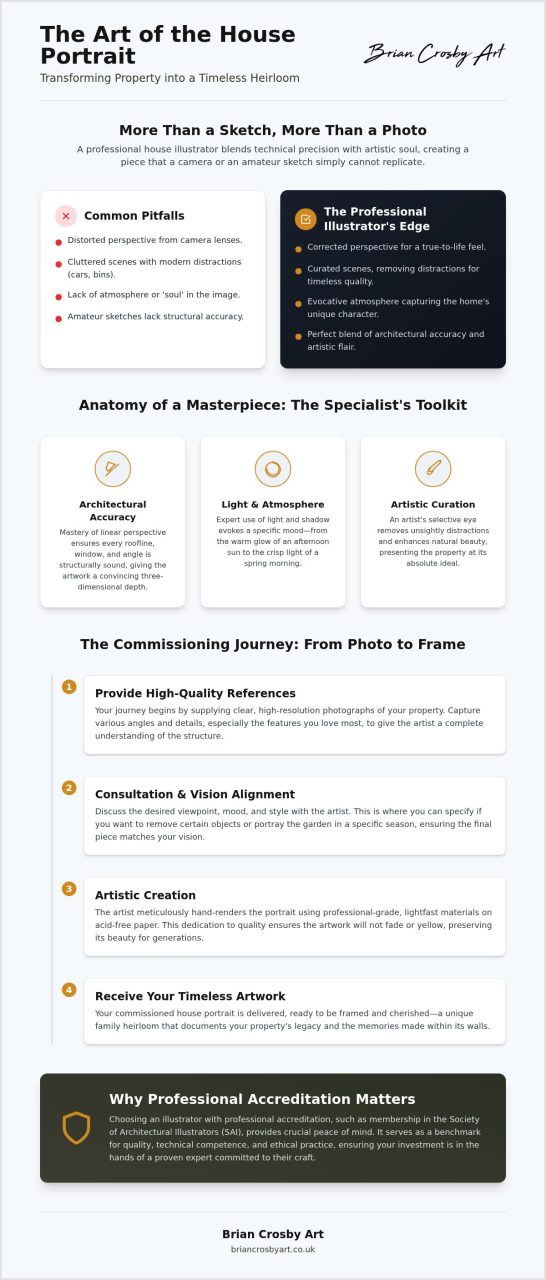
A professional house illustrator acts as a bridge between the rigid world of blueprints and the fluid world of fine art. Unlike a general artist who might sketch a broad landscape, these specialists focus entirely on the accurate yet aesthetic depiction of buildings, specialising in the fine details that make a structure unique. This field of architectural illustration demands a deep respect for the craft of the original builders and an eye for the small features that define a property. It isn’t just about drawing four walls; it is about understanding how those walls hold history and catch the light at different times of the day.
Owners of heritage properties and cherished family homes often seek out these specialists because a camera lens can feel cold and detached. A photograph captures a single, static moment, often with perspective distortions that make a stately building look tilted or flat. In contrast, a bespoke portrait breathes life into the structure. It balances the rigid rules of perspective with a “soul” that reflects the many years of memories lived within those walls. This is why a commissioned painting becomes a treasured heirloom, passing down the unique story of a home through the generations. It offers a sense of permanence that digital files simply cannot match.
The Skills of an Architectural Specialist
Mastery in this field begins with a firm grasp of linear perspective. A professional house illustrator uses these rules to ensure every roofline and window frame sits perfectly in space, providing three-dimensional depth. It’s a skill often honed through years of practice and a deep understanding of light and shadow. Whether working from old family photos or modern images, the artist interprets these references to create a balanced and grounded composition.
Preserving History Through Illustration
Heritage properties benefit from the illustrator’s touch because a painting transcends the limitations of a lens. Cameras often distort vertical lines or struggle with high-contrast sunlight. An illustrator can curate the scene, perhaps softening a glare or highlighting intricate masonry. This process creates a timeless quality, stripping away modern distractions to reveal the building’s enduring character. It’s why families choose an original painting to document their home’s history.
Evaluating the Quality of a House Portrait
Judging the quality of a house portrait requires looking beyond the immediate visual appeal to understand the “bones” of the drawing. A skilled professional house illustrator ensures the underlying structure is sound before ever applying colour. Perspective must be accurate; if the chimney looks as though it is sliding off the roof or the windows appear misaligned, the whole piece loses its sense of place. Line work serves as another key indicator of quality. Whether it is a precise ink drawing or a softer, atmospheric sketch, every stroke should feel intentional. These lines define the building’s weight and presence on the paper.
Colour harmony also plays a vital role in the final result. It isn’t simply a matter of matching the exact paint on the front door. Instead, it involves using light and shadow to evoke a specific mood, perhaps the golden warmth of a summer afternoon or the cool, quiet stillness of a spring morning. Truly successful architectural commissions capture the “character” of a home. This character is found in the nuances: the specific way ivy climbs a gable or the weathered texture of old stone. These details tell a story that goes far beyond physical measurements.
Accuracy vs. Artistic Interpretation
A camera is literal, but an artist is selective. A professional house illustrator knows exactly when to use artistic licence to improve a composition. This often involves removing modern distractions that clutter a photograph, such as plastic wheelie bins, satellite dishes, or parked cars. By carefully enhancing the landscaping or showing the garden in its peak seasonal bloom, the artist presents the property at its absolute best. This curation ensures the artwork remains a timeless representation of the home, free from the fleeting eyesores of modern life.
Mediums and Materials
Longevity is a hallmark of professional work. For commissioned house portraits UK, the choice of materials is just as important as the technique itself. High-quality, acid-free papers and lightfast pigments prevent the artwork from yellowing or fading when exposed to sunlight. Standards championed by organisations like the American Society of Architectural Illustrators (ASAI) highlight how these technical benchmarks separate professional art from amateur sketches. Choosing hand-rendered originals over digital alternatives ensures your portrait possesses a tactile, heirloom quality. These materials guarantee the piece remains a vibrant part of your family history for many decades to come.
Choosing the Right Style for Your Property
Selecting the right medium is a vital step in the commission process. A professional house illustrator understands that the artistic style must complement the building’s specific architecture. For instance, a timber-framed Tudor cottage often suits the detailed, descriptive lines of ink and watercolour, whilst a sleek Modernist home with its clean lines and glass surfaces might require the crisp, technical precision of gouache to truly shine. The goal is to choose a style that highlights the property’s best features without overwhelming its natural character. This bespoke approach ensures the final piece feels like a natural extension of the home itself.
Traditional architectural commissions often borrow techniques from the world of portraiture, treating the building as a living subject with its own personality. By focusing on the unique textures of the site, such as the distinctive honey-hued stone surfaces or the rhythmic patterns of Victorian brickwork, the artist creates a sense of place that a standard photograph simply cannot replicate. The Society of Architectural Illustrators (SAI) highlights how these diverse styles help to document our built environment with both accuracy and artistic soul.
Watercolour and Ink: The Classic Choice
Watercolour remains the most requested medium for residential illustrations across the UK. Its popularity stems from its ability to capture the soft, shifting light of the British countryside with atmospheric warmth. By using ink as a structural skeleton, the artist provides the necessary precision for gables and windows, allowing the fluid paint to wash over the surface. This combination is particularly effective for capturing the weathered charm of older properties, where the lines aren’t always perfectly straight and the colours have softened over time.
Oil and Acrylic: Adding Depth and Grandeur
Whilst watercolour offers a delicate touch, some properties demand more gravitas. Heavier mediums like oil or acrylic are ideal for larger-scale house portraits where depth and vibrant colour are paramount. These paints allow for rich textures and a sense of permanence that mirrors the substantial nature of a stone-built estate. Choosing a style similar to traditional portrait painting commissions adds a layer of grandeur to the work. This approach is well-suited for formal entranceways or expansive views where the play of light on masonry needs a more robust, textured application to feel truly authentic.
The Commissioning Process: From Photo to Frame
The journey to a finished artwork is a shared experience between the client and the artist. A professional house illustrator doesn’t just work in isolation; they begin by helping you select the best possible viewpoint for the composition. This ensures the final piece feels balanced, welcoming, and captures the building’s true personality. It isn’t just about clicking a button. It is a partnership that starts with a conversation about which features you cherish most, whether it’s an ornate porch, a specific chimney stack, or the way the garden frames the front door.
Capturing the Perfect Reference
Taking high-quality photographs is the first step toward a successful commission. Aim for a bright, clear day when the sun is behind you, as this illuminates the facade without creating harsh, confusing shadows. Try to avoid standing too close to the property, which can cause the vertical lines of the house to look as though they are leaning inward. If your home has been altered over the years or is no longer standing, a skilled illustrator can work from a collection of older family photos. By using professional image restoration techniques, the artist can piece together a complete picture of the property as it once was, effectively bringing your family history back to life on the page.
Reviewing the initial sketches is a vital part of this collaborative phase. This stage allows you to provide feedback on the proportions and specific details before the final paint or ink is applied. It’s a reassuring way to ensure the artwork matches your vision exactly, giving you total confidence in the progress of the piece. Once the artwork is complete, the focus shifts to how it will be displayed and preserved within your home.
The Finishing Touches: Framing Your Art
A bespoke original deserves a presentation that reflects its value as a family heirloom. Choosing the right surround is about more than just aesthetics; it is about long-term preservation. Selecting mount colours and frame styles that complement both the artwork and your interior decor can significantly enhance the mood of the work. For those looking for the highest standards of presentation, exploring Creative framing services Gloucestershire provides excellent guidance on protecting your investment.
The final result should be a piece of art that feels ready to hang and pass down through the generations. If you are ready to start this rewarding process, you can enquire about a bespoke architectural commission today. Professional presentation ensures that your new heirloom is not only beautiful but also protected from the elements for many years to come.
Why Professional Accreditation Matters in Illustration
Choosing a professional house illustrator is a decision to trust an artist with the legacy of your most significant asset. Whilst many hobbyists can produce a charming sketch, a high-value commission requires a level of technical mastery that only comes with formal training and recognised accreditation. This distinction is vital when you want a piece that accurately reflects the complex angles and proportions of a building. An accredited artist provides peace of mind, ensuring that the final artwork is not only beautiful but structurally sound and created using materials that will stand the test of time.
The difference often lies in the artist’s background. A qualified art educator, for instance, understands the physics of light and the mathematics of perspective in a way that a self-taught enthusiast might miss. Brian Crosby Art combines this professional technique with a personal, supportive approach, acting as a friendly mentor throughout the creative journey. This ensures that the process is as rewarding as the final result, making the world of fine art feel accessible and encouraging for every client.
The Society of Architectural Illustrators (SAI)
The gold standard in this field is membership in the Society of Architectural Illustrators (SAI). Membership is not simply handed out; it involves a rigorous selection process where an artist’s portfolio is scrutinised for technical excellence and aesthetic quality. These standards ensure that every The Society of Architectural Illustrators artist possesses the skills necessary to handle complex architectural representation. When you commission an SAI member, you are hiring a professional who is committed to the highest benchmarks of the craft, from the first pencil stroke to the final wash of colour.
Investing in a Lasting Legacy
A bespoke house portrait is more than just a decoration. It is an investment in your family history. Whether it is a treat for yourself or a deeply personalised anniversary art gift for a loved one, the emotional impact of seeing a home captured in paint is profound. It documents a specific chapter of your life in a way that feels permanent and significant. For those looking to understand the market better, the Commissioned House Portraits: UK Buyer’s Guide 2026 offers comprehensive advice on making an informed choice. By choosing a professional house illustrator with the right credentials, you ensure that your property’s story is told with the respect and skill it truly deserves.
Preserve the Story of Your Home
Your home is a repository for cherished memories and a witness to your family’s history. You now understand how a professional house illustrator uses technical precision to honour those stories, ensuring every detail from the weathered brickwork to the soft garden light is captured with care. By choosing an artist with recognised credentials, such as membership in the Society of Architectural Illustrators (SAI), you ensure your property is rendered with the structural integrity it deserves. This blend of architectural discipline and artistic soul creates a legacy that lasts for generations.
The journey from a simple photograph to a framed original is a rewarding collaboration that celebrates your unique connection to a place. Brian Crosby Art provides expert hand-painted originals and limited edition prints, supported by bespoke framing and image restoration services. If you’re ready to transform your residence into a timeless work of art, commission your bespoke house portrait with Brian Crosby Art today. It is a wonderful way to celebrate where you’ve been and the beautiful spaces you call home.
Frequently Asked Questions
How much does a professional house illustrator charge for a commission?
Fees for a bespoke architectural commission are typically determined by the complexity, size, and chosen medium of the piece. Each project is unique, so a fixed price isn’t set until the specific requirements are discussed. Factors such as the level of architectural detail and whether you require a hand-painted original or a limited edition print will influence the final cost. It’s best to discuss your vision directly to receive an accurate quote.
Can a house illustration be done from a single photograph?
Yes, a house portrait can be created from a single photograph, provided it is clear and shows the building’s main features. However, providing additional photos from different angles helps the artist understand the three-dimensional structure more effectively. A professional house illustrator uses these references to ensure every roofline and window is technically accurate. If you only have one historic or damaged photo, the artist can often use image restoration techniques to fill in any missing details.
How long does it typically take to complete a bespoke house portrait?
The timeline for a commissioned artwork varies depending on the artist’s current schedule and the intricate nature of the building. Typically, the process involves an initial consultation, the creation of preliminary sketches for your feedback, and the final painting or drawing. This collaborative approach ensures you are happy at every stage. You should usually allow several weeks for the creation of a high-quality original, especially if you also require professional framing or image restoration services.
What is the best medium for a traditional British home illustration?
Watercolour and ink is often considered the classic choice for documenting British architecture. This medium captures the soft, atmospheric light and weathered textures of stone and brickwork with great warmth. Whilst watercolour is popular, heavier mediums like oil or acrylic can provide a sense of grandeur for larger estates. The best choice depends on your property’s style and your personal preference for either a delicate, detailed sketch or a more substantial, textured painting.
Can the illustrator remove modern features like satellite dishes or cars?
Yes, an artist can easily omit modern distractions like satellite dishes, wheelie bins, or parked cars that might clutter a standard photograph. This allows the timeless character of the architecture to shine through. The artist can also enhance the landscaping or show your garden in full bloom, ensuring the final portrait represents your home at its absolute best. This curation ensures that your property is presented as a beautiful, lasting legacy that isn’t dated by temporary eyesores.
Is it possible to commission a portrait of a house that no longer exists?
It is entirely possible to recreate a building that has been demolished or significantly altered. By working from old family photographs, maps, or even architectural plans, the artist can piece together a complete and accurate representation of the property. This service is a wonderful way to preserve family history and create a lasting legacy of a childhood home or a lost heritage site. The artist’s expertise in perspective ensures the reconstructed image feels grounded and real.
Does a professional house illustrator provide framing as part of the service?
Many professional artists offer creative framing as an integral part of their service. Providing a bespoke frame ensures that your original painting is not only beautifully presented but also protected for the long term. Using high-quality, acid-free mounts and suitable glass prevents the artwork from fading or yellowing over time. This professional finish transforms the commission into a ready-to-hang heirloom, allowing you to display your property’s portrait with confidence as soon as it arrives.
What makes an architectural illustrator different from a regular landscape artist?
An architectural specialist focuses on the technical precision of man-made structures, whereas a landscape artist often captures broader, organic scenery. This role requires a deep understanding of linear perspective, structural proportions, and the way light interacts with masonry. A professional house illustrator blends this technical discipline with artistic flair to capture the “soul” of a building. They treat the house as the primary subject, ensuring every gable and window is rendered with accuracy that a generalist might overlook.
[…] it might be the perfect entry point for those considering a more personal project. Working with a professional house illustrator ensures that every gable, window pane, and shadow is rendered with both structural accuracy and a […]
[…] stone, brick, and slate. This level of detail is essential for anyone interested in the role of a professional house illustrator. It’s about more than just drawing a building; it’s about capturing the history and […]