

What if your lack of experience isn’t a hurdle, but actually a clean slate for learning professional techniques the right way? It’s completely natural to feel a bit of trepidation when considering beginner painting classes. You might worry about being the least experienced person in the room or feel overwhelmed by the endless aisles of brushes and paints at the local shop. Many adults hesitate because they don’t want to waste money on a class that feels too academic or, conversely, too social without any real instruction.
This guide will help you navigate those initial worries, showing you how to select a class that matches your pace while providing the expert tuition you need to move past that intimidating blank canvas. We’ll explore how to find a supportive creative community, understand the basics of colour theory, and finally gain the confidence to create original work you’re proud to display. The right environment should feel like a quiet sanctuary where you can focus on the play of light and the steady, rewarding progress of your own hand.
Key Takeaways
- Discover how a structured approach to art can become a rewarding creative outlet, offering both mental clarity and a sense of personal achievement.
- Learn why choosing the right beginner painting classes Cheltenham is essential for mastering foundational techniques like composition and colour theory from day one.
- Identify the key differences between casual social painting events and professional, artist-led tuition to find the path that best supports your long-term growth.
- Overcome the common fear of the blank canvas with a clear preparation checklist and a supportive environment that treats every mistake as a learning opportunity.
- Understand the unique benefits of learning from a qualified professional who can adapt their teaching style to your individual pace and creative goals.
Why Art Lessons for Adults with No Experience are the Perfect Creative Outlet
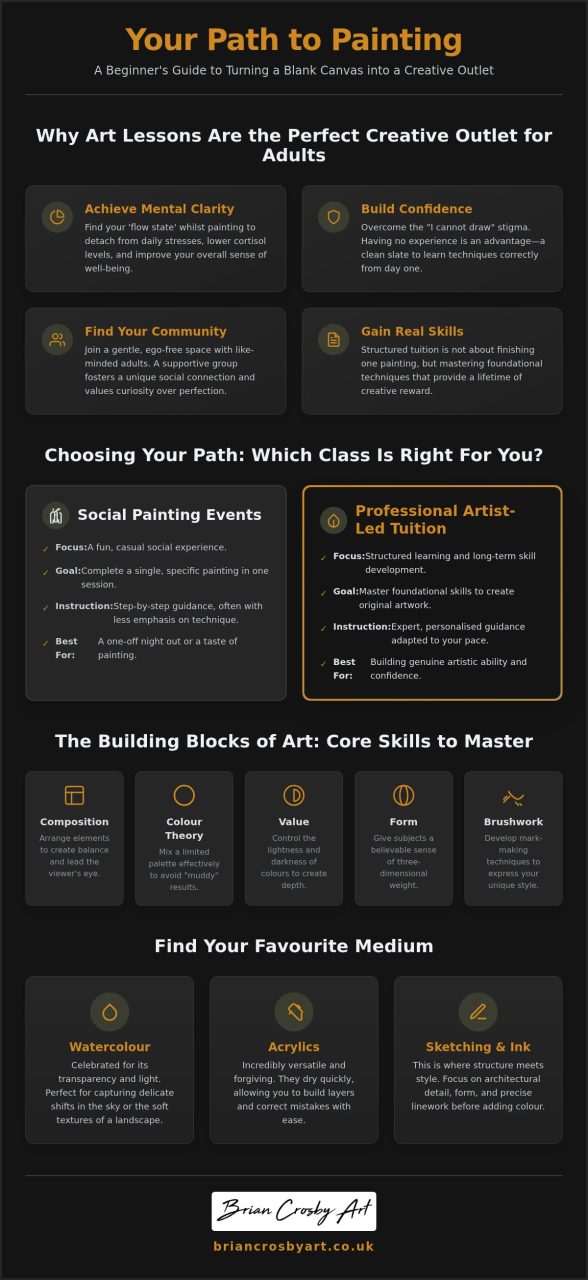
Adult art tuition isn’t just about making pictures. It’s a structured path to rediscovering a part of yourself that might have been tucked away for years. Many people think they need a “gift” to start, but technique is a skill that anyone can learn with the right guidance. Stepping into beginner painting classes Cheltenham provides a gentle, ego-free space where the focus is on your personal journey rather than comparing yourself to others. This inclusive atmosphere allows you to progress much faster because you aren’t worried about being the “worst” in the room. Instead, you’re part of a community that values curiosity over perfection and celebrates the quiet joy of creating something new.
The Mental Health Benefits of Creative Learning
There’s a profound sense of tranquility found in the “flow state” of painting. Whilst you’re deciding which brush to use or how to layer a wash, your mind naturally detaches from daily stresses. This creative immersion is known to lower cortisol levels and improve overall mental clarity. It’s a chance to slow down in a fast-paced world. Learning amongst a group of like-minded adults also offers a unique social connection, fostering a sense of belonging that is often missing from solitary hobbies. You don’t need to be a professional to feel the restorative power of a few hours spent at the easel.
Breaking the “I Cannot Draw” Stigma
The biggest hurdle for most beginners is the belief that they lack innate talent. Drawing and painting are primarily about learning how to see, not just how to move a pencil. In many ways, having no prior background is a secret weapon. You’re a clean slate, ready to absorb correct techniques without the baggage of old misconceptions. A qualified teacher acts as a friendly guide, helping you unlearn the idea that art is a “magical” ability. When you join beginner painting classes Cheltenham, you’ll discover that once you understand basic structure and form, the canvas becomes a place of possibility rather than a source of anxiety. With patient tuition, those initial “mistakes” simply become the foundation for your next piece of work. It’s about building confidence one brushstroke at a time, guided by someone who understands the technical structure behind every beautiful image.
Choosing the Right Curriculum: Mediums, Techniques, and Teaching Styles
A well-structured curriculum acts as a roadmap for your creativity. It transforms the overwhelming world of art into a series of manageable, rewarding steps. When searching for beginner painting classes Cheltenham, it’s vital to choose a programme that focuses on the core pillars of fine art rather than just finishing a single project. High-quality tuition prioritises foundational skills like value, which is the lightness or darkness of a colour, and form, which gives your subjects a sense of three-dimensional weight. These elements are the quiet engines that make a painting feel “right” to the viewer’s eye.
Foundational Skills Every Beginner Should Master
Before diving into complex landscapes, you’ll benefit from understanding how to lead the eye through a composition. A good curriculum teaches you how to arrange elements on your paper to create balance and interest. You’ll also explore colour theory by learning to mix a limited palette effectively. This approach prevents the frustration of “muddy” colours and helps you understand the relationships between different hues. Mastering simple brushwork and mark-making techniques early on builds the physical confidence needed to express your unique artistic voice. If you’re ready to start this journey, exploring art lessons for beginners can provide the structured guidance you need.
Finding Your Preferred Medium
Choosing your first medium is a personal decision based on the atmosphere you wish to create. Each material offers a different sensory experience and set of rewards:
- Watercolour: Celebrated for its transparency and light. It’s perfect for capturing the delicate shifts in a British sky or the soft textures of a landscape.
- Acrylics: These are incredibly versatile and forgiving. Because they dry quickly, you can build up layers of depth and correct mistakes easily, making them a favourite for those new to the easel.
- Sketching and Ink: This is where structure meets style. Using pen and ink allows you to focus on architectural detail and tone. This is a particular speciality of mine, drawing on my background with the Society of Architectural Illustrators to teach you how perspective really works.
Focusing on architectural landscapes is an excellent way to learn perspective. It provides a clear framework for understanding how lines recede and how buildings sit within their environment. This structural drawing isn’t about rigid perfection; it’s about giving your work a believable sense of space and character. By focusing on these techniques, you’ll move beyond simple copying and begin to understand the “why” behind every mark you make.
Comparing Your Options: From Social Events to Professional Tuition
When searching for beginner painting classes Cheltenham, you’ll quickly notice a broad spectrum of teaching styles and environments. At one end, there are the popular “Sip and Paint” events. These are wonderful for a lighthearted evening with friends, but they rarely focus on long-term skill development. Participants often follow a single, pre-determined image, leaving with a finished canvas but perhaps without the tools to start their own work at home. They are social experiences first and educational ones second.
At the other end, community college courses offer a more academic approach. Whilst these are valuable, they often involve larger class sizes where individual attention is limited. It’s difficult for a tutor to provide nuanced feedback when managing twenty different students at once. Independent studio tuition occupies the vital middle ground. It offers high-level expertise with a personal touch that ensures you aren’t just another face in a crowd. For a deeper look at what’s available locally, you might find Adult Art Classes in Cheltenham: A Resource for Artists a helpful starting point.
Social Painting vs. Skill-Based Learning
Choosing between a one-off workshop and a multi-week technical course depends on your ultimate goal. If you want a fun distraction, a social evening is perfect. However, if you want to find your own artistic voice, you need consistent, skill-based learning. Professional guidance is essential to prevent common beginner plateaus, such as struggling with perspective or failing to understand how light interacts with different surfaces. A mentor helps you see these patterns early, saving you hours of frustration. This structured feedback loop is what transforms a hobby into a lifelong passion and allows you to create original work from scratch.
The Advantages of Small Group Workshops
Small group settings provide a unique balance of individualised attention and peer learning. In a smaller class, the pace is naturally more flexible and student-led. If the group is struggling with a specific technique, like mixing a particular shade of green for a landscape, we can pause and explore it together. There is also immense value in seeing how your peers interpret the same subject. Observing the different brushstrokes and colour choices of others in your beginner painting classes Cheltenham fosters a supportive environment where everyone learns from each other. It’s a gentle way to build confidence whilst benefiting from a shared creative energy that larger, more anonymous classes simply cannot replicate.
Overcoming Blank Canvas Anxiety: How to Prepare for Your First Class
The pristine, white surface of a new canvas can be surprisingly intimidating. This “fear of the empty” is something almost every artist faces, regardless of their experience level. In my beginner painting classes Cheltenham, we address this head-on by treating the first mark as a discovery rather than a final statement. One of the best ways to lower the stakes is through sketchbook play. Before your brush ever touches the canvas, we use sketchbooks to explore loose shapes and tonal values. This playground allows you to make mistakes, test ideas, and warm up your hand without the pressure of producing a masterpiece.
Setting realistic expectations is equally important for your first few sessions. You aren’t there to paint a gallery-ready portrait in two hours. You’re there to learn the behaviour of the paint and the rhythm of the brush. Most studios, including mine, provide the larger equipment like easels and drawing boards, but having your own small kit helps you maintain momentum at home. If you’re feeling ready to move past the hesitation, you can book your place in our art lessons for beginners and start your creative journey in a supportive environment.
Essential Materials for the New Artist
Whilst it’s tempting to buy every tube of colour in the shop, a limited, high-quality kit is far more effective for learning. Quality materials matter because poor-grade paints often have less pigment, leading to muddy results that can be very frustrating for a beginner. To start, I recommend a basic set of “artist grade” primary colours, a few versatile synthetic brushes, and a pad of heavy-duty paper. Organising a small, dedicated corner at home for these supplies encourages daily practice. Even fifteen minutes of sketching a simple object from your kitchen can help solidify the techniques we cover in our beginner painting classes Cheltenham.
Mental Preparation for Creative Growth
Every painting goes through what artists often call the “ugly stage.” This is the midpoint where the initial sketch is gone, but the final details haven’t yet pulled the image together. Recognising that this stage is a necessary part of the process helps you stay calm and keep working. Learning to receive constructive critique is another vital step in your growth. In a small group, we look at work with a positive, growth-oriented mindset, focusing on what’s working well and where the next small improvement lies. By setting tiny, achievable goals for each session, such as “today I will focus purely on mixing the right shadow tones,” you’ll find that your confidence grows naturally alongside your technical ability.
Why Professional Artist-Led Tuition Makes the Difference
Choosing a guide who lives and breathes their craft transforms the learning experience. It’s the difference between following a set of instructions and understanding the soul of the medium. In beginner painting classes Cheltenham, having a tutor who is also a working artist means you’re learning shortcuts and professional secrets that aren’t found in textbooks. These insights help you move past the “how” and into the “why” of every artistic decision, from the choice of a specific pigment to the angle of a brushstroke.
A qualified teacher doesn’t just deliver a lecture; they observe your behaviour at the easel. Some students find confidence through bold, expressive marks, whilst others prefer the quiet precision of a fine-liner. Recognising these individual traits allows for a personalised approach that respects your pace. Seeing the professional finish of Traditional Portrait Painting Commissions serves as a powerful reminder of where these foundational skills can lead. It bridges the gap between a simple classroom exercise and a piece of timeless art, providing tangible inspiration for your own journey.
Learning from a Master of Architectural Illustration
My professional background with the Society of Architectural Illustrators brings a unique level of structure to our sessions. We don’t just “guess” where a window or a horizon line should go. Instead, we apply the precision of architectural art to general landscape techniques, ensuring your work has a solid, believable foundation. This professional standard elevates your accuracy from the very first sketch. It helps you avoid the common pitfalls that often discourage self-taught artists, such as skewed perspectives or flattened forms. By learning these structural rules early, you gain the freedom to eventually break them with confidence and intent.
Your Next Steps: From Pupil to Artist
The end of an introductory course is really just the beginning of your creative journey. As you move from beginner to improver, the focus shifts towards developing a personal style and perhaps even exploring your own commissions. Keeping the momentum going is key to long-term growth. Whether you’re interested in architectural landscapes or intimate portraits, the creative community we build in beginner painting classes Cheltenham provides ongoing support. There are always opportunities for exhibiting your progress or simply enjoying the tranquil process of starting a new piece. The best time to start was yesterday; the second best is today. Let’s pick up the brush together and see what you can create.
Start Your Creative Journey Today
Learning to paint as an adult is a rewarding path that prioritises your personal growth over the pressure of perfection. We’ve explored how a structured curriculum and the right materials can transform your approach, turning initial blank-canvas anxiety into a calm, focused flow state. By choosing professional, artist-led beginner painting classes Cheltenham, you ensure that every technique you learn is backed by sound expertise and supportive, individualised feedback.
As a qualified art teacher and a member of the Society of Architectural Illustrators, I specialise in helping students find their confidence in small, friendly groups. These sessions are designed to be a tranquil escape where you can master foundational skills amongst a supportive local community. You don’t need “natural talent” to begin; you simply need the curiosity to try and the right environment to grow.
If you’re ready to pick up the brush, please enquire about adult art lessons with Brian Crosby Art today. There’s a world of light and atmosphere waiting for you to capture it on canvas.
Frequently Asked Questions
Do I need to bring my own art supplies to the first lesson?
You don’t need to worry about heavy equipment like easels or drawing boards, as these are typically provided by the studio. For your first session, it’s often helpful to bring a basic sketchbook and pencils to capture initial ideas. As you progress, I’ll guide you on which specific paints and brushes will best suit your chosen medium. This approach ensures you don’t waste money on unnecessary materials before you’ve found your creative rhythm.
How many people are usually in an adult art class?
To ensure everyone receives the personalised feedback they deserve, classes are kept to small, intimate groups. This environment allows me to spend time with each student individually, addressing your specific questions and helping you overcome technical hurdles. Working in a smaller setting also fosters a friendly, supportive atmosphere amongst peers. It’s much easier to build confidence and share ideas when you aren’t just another face in a crowded room.
What happens if I miss a session in a multi-week course?
If you happen to miss a session, don’t feel discouraged or worry that you’ve fallen behind. The structure of my beginner painting classes Cheltenham is designed to be flexible and supportive of your personal progress. We can usually catch up on key concepts during the following lesson. Since the focus is on building foundational skills rather than racing to a finish line, you’ll find it quite natural to pick up where you left off.
Can I learn to paint if I have never been good at drawing?
You can certainly learn to paint even if you’ve always felt you “couldn’t draw” a straight line. Painting is more about learning to observe light, shadow, and the behaviour of different mediums than it is about having a magical talent for sketching. We start with the basics of seeing like an artist, breaking down complex subjects into simple shapes. With patient tuition, you’ll soon find that drawing is a teachable skill that serves as a foundation for your brushwork.
Are these classes suitable for seniors as well as younger adults?
These classes are perfectly suited for seniors and younger adults alike, creating a diverse and vibrant creative community. Art is a wonderful way to maintain cognitive focus and find relaxation at any stage of life. Whether you’re looking for a new hobby in retirement or a creative outlet after work, you’ll find the environment inclusive and patient. The shared goal of personal growth brings together people of all ages who appreciate the beauty of fine art.
How long does it take to see real improvement in my painting?
Most students begin to see a real improvement in their confidence and technical understanding after just a few sessions. Whilst mastering fine art is a lifelong journey, understanding core principles like colour mixing and composition provides immediate results. You’ll notice your work becoming more structured and your observations more acute. Steady practice at home, even for short periods, helps to solidify the professional techniques we cover during our time together in the studio.
Is there an age limit for adult art classes?
There is no upper age limit for joining our creative community, as these sessions are designed for all adult learners. Whether you are eighteen or eighty, the focus remains on your individual progress and the joy of the creative process. The studio is a welcoming space for anyone who wishes to explore their artistic side in a professional yet neighbourly atmosphere. It’s never too late to start learning the structure and beauty of architectural landscapes or portraits.
What is the difference between a beginner and an improver class?
Beginner classes focus on the essential building blocks of art, such as colour theory, basic perspective, and mark-making. In contrast, improver sessions are designed for those who have mastered the basics and wish to refine their personal style. These advanced lessons delve deeper into complex compositions and more sophisticated techniques. Both levels benefit from the same supportive environment, but the improver stage allows for more independent exploration and nuanced feedback on your developing body of work.