


You sit at your kitchen table with a fresh canvas, yet the pre-recorded video on your laptop feels miles away from the stroke of your own brush. It’s a common hurdle for many aspiring artists who find themselves stuck in the cycle of self-teaching, where the lack of immediate feedback makes progress feel slow and uncertain. Whilst digital tools have their place, they often lack the human touch needed to truly master the nuances of light, colour, and shadow. Small group art tuition offers a refreshing alternative, bridging the gap between the isolation of home study and the overwhelming noise of a crowded classroom.
We understand that the fear of being judged can often hold back your creative spirit. That’s why a supportive, intimate environment is so vital for personal growth. In this guide, you’ll discover how small group art tuition provides the perfect balance of professional mentorship and peer inspiration to accelerate your creative journey. We will explore how tailored guidance helps you gain confidence in basic techniques, develop a personal artistic style, and finally find the creative community you’ve been looking for. It’s time to move beyond the screen and see your work flourish with the steady, patient support of a mentor who genuinely cares about your progress.
Key Takeaways
- Small group art tuition creates an intimate learning environment of four to eight students, offering far more personal attention than a crowded community centre class whilst retaining a supportive social atmosphere.
- Gain immediate feedback on your technique from a qualified mentor, allowing you to correct mistakes in real-time and avoid the “stuck” feeling of self-guided study.
- Learn to evaluate a tutor’s portfolio for specific expertise, such as architectural landscapes or portraits, to ensure their professional style aligns with your own creative goals.
- Experience the unique benefits of peer learning, where seeing how others solve visual challenges provides fresh inspiration and helps you master complex concepts like perspective and light.
- Follow a structured journey from beginner to improver, moving beyond the fear of the blank page to develop a personal style with confidence and technical skill.
Beyond the Crowded Classroom: What is Small Group Art Tuition?
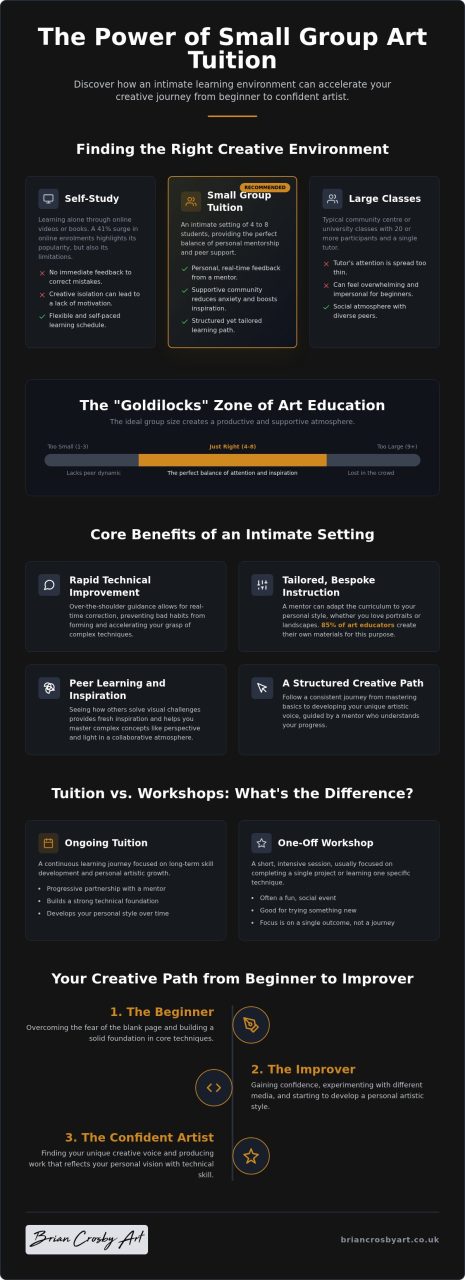
Small group art tuition isn’t just about painting in a room with others; it’s a deliberate choice for focused, high-quality learning. Whilst 2026 has seen a 41% surge in online art training enrolments, many students find that digital screens can’t replace the presence of a physical mentor. This has led to a renewed interest in intimate creative spaces. Typically, these sessions involve four to eight students, ensuring the environment remains calm and conducive to concentration. It’s a far cry from the bustling community centre where a single tutor might be spread thin across twenty or more participants.
This model prioritises tailored instruction within a shared creative space. It draws on the rich history of visual arts education, where the relationship between the mentor and the student is central to progress. By keeping numbers low, the tutor can provide specific guidance on your unique challenges. You might be struggling with the perspective of a complex architectural landscape or the subtle skin tones in a portrait. Having a professional who can step in immediately ensures you don’t spend hours repeating the same mistakes.
The “Goldilocks” Zone of Art Education
Finding the right group size is essential for a productive atmosphere. Four to eight students represents the ideal balance for group dynamics. It’s enough people to foster a sense of community and shared inspiration, yet small enough that you never feel like a face in the crowd. This format naturally reduces the performance anxiety many beginners feel in larger settings. You have the space for independent practice, but you’re never more than a few moments away from a quiet word of encouragement or a technical correction. It creates a tranquil rhythm that mirrors the patient nature of the artistic process itself.
Tuition vs. Workshops: Understanding the Difference
It’s helpful to distinguish between a one-off workshop and ongoing tuition. Workshops are often wonderful social events, but they usually focus on completing a single project in a few hours. In contrast, small group art tuition is a continuous learning journey. Having a consistent mentor who understands your personal progress is invaluable. They know exactly where you started and where you want to go, helping you transition from a beginner to an improver with a structured plan. Art tuition is a progressive partnership between artist and educator that evolves as your skills grow.
The Core Benefits of Learning in an Intimate Setting
The atmosphere of a dedicated studio is transformative. It acts as a sanctuary where the outside world fades away, allowing for a level of concentration that’s hard to achieve at home. In small group art tuition, this focus is sharpened by the presence of others who share your passion. You aren’t just another face in a crowded hall; you’re part of a small circle where every brushstroke matters. This environment fosters a unique blend of quiet study and collaborative inspiration, providing the psychological space needed to explore new techniques without the pressure of a large audience.
A structured curriculum is essential, but it shouldn’t be a cage. In an intimate setting, a qualified mentor can adapt the lesson to fit your personal style. Perhaps you’re drawn to the crisp lines of architectural illustration or the soft gradients of a portrait. Because 85% of art educators create their own instructional materials, according to 2026 industry reports, you benefit from a bespoke approach that respects your creative choices whilst keeping you on a path of steady progress. It’s about finding your own voice amongst a handful of supportive peers.
Rapid Technical Improvement through Feedback
Bad habits are easy to form and difficult to break. When you’re self-teaching, you might not notice a subtle error in your grip or the way you’re layering your washes. Over-the-shoulder guidance allows for real-time technique correction that prevents these habits from taking root. Seeing a professional artist demonstrate a stroke in person is a revelation. You can observe the exact pressure applied to the paper and the fluidity of the movement in a way that a digital screen simply can’t capture. This immediate feedback is far superior to waiting for a critique in a large class, where your specific needs might be overlooked.
The Social Catalyst for Creativity
Art can be a lonely pursuit, but it doesn’t have to be. Developing a favourite weekly routine amongst like-minded individuals provides a powerful boost to your motivation. There’s a certain magic in the “peer learning” effect. Observing how a fellow student mixes a specific colour palette or tackles the challenge of perspective can spark an idea for your own work. This supportive nature is especially helpful when you’re facing “productive difficulty”, those moments where the creative process feels challenging but ultimately rewarding. If you’re ready to move beyond the basics, exploring art lessons for improvers can help you find that perfect balance of challenge and community.
Comparing Tuition Models: Which Format Suits Your Style?
Choosing the right learning environment is as vital as selecting your favourite brushes. Every artist has a unique temperament; some thrive in silence whilst others need the buzz of a crowd. Solo learning often feels safe but can quickly become lonely. Without a mentor to spot your “blind spots”, you might find your progress stalls. On the other end of the scale, large workshops can feel chaotic. When twenty people are vying for attention, the tutor becomes a performer rather than a guide. Small group art tuition bridges this gap by offering a calm, structured space that respects your individual pace.
Small Group vs. One-to-One Mentorship
Private lessons offer the highest intensity of instruction. They’re perfect for tackling a very specific, complex goal in a short time. However, they come with a higher price tag and lack the social warmth that many artists crave. Sharing the mentor’s time in a small group makes professional guidance much more cost-effective. You still receive regular, personal feedback, but you also gain the advantage of diverse perspectives. Seeing how a peer handles the play of light on a portrait can be just as educational as the tutor’s own demonstration. There are times when you might want to transition to one to one art tuition for a bespoke project, but for consistent growth, the group dynamic is hard to beat.
The Problem with Large Community Classes
Many students start in large community centre classes, only to feel “lost in the crowd” after a few weeks. Because the numbers are so high, the tutor often defaults to a “one size fits all” project. Everyone paints the same subject at the same speed. This leaves little room for individual progress tracking or personal style development. In contrast, an intimate setting allows art tuition for improvers to be truly bespoke. Your mentor can adjust the programme based on your specific interests, whether you want to master the intricate details of architectural illustration or capture the character in a portrait. It turns a generic hobby into a tailored creative journey that evolves as you do.
What to Look for in a Small Group Art Tutor
Finding the right mentor is about more than just admiring their paintings. In the context of small group art tuition, the tutor’s ability to communicate is just as vital as their skill with a brush. You need a guide who doesn’t just show you what to do but explains the underlying principles. A qualified educator understands the “why” behind the “how”. According to 2026 data, nearly 60% of art educators now hold advanced degrees, reflecting a shift towards professionalised instruction. Look for someone who holds memberships in prestigious bodies, such as the Society of Architectural Illustrators, which signifies a high level of technical mastery and professional standing.
The Importance of a Qualified Educator
Being a gifted artist doesn’t automatically make someone a gifted teacher. Teaching requires patience, a structured approach, and the ability to break down complex subjects like perspective or anatomy. A mentor who specialises in architectural landscapes or portraits can offer deep insights into specific genres. They help you see the world through a professional lens, noticing the play of light on a stone wall or the character in a person’s expression. This expertise ensures your time in the studio is productive and your progress is measurable. It’s about finding a craftsman who is genuinely passionate about sharing their knowledge.
Assessing the Learning Environment
The physical space where you learn has a profound impact on your creativity. A dedicated studio offers consistent lighting and professional equipment that you simply won’t find at a dining room table. It sets a tone of serious, focused study whilst remaining warm and welcoming. High-quality materials and proper easels allow you to work with precision. Presentation is also a key part of the artistic journey. Learning about creative framing helps you understand how to finish and display your work, turning a simple study into a piece of art ready for the wall. A professional setting inspires better work and respects your time as an artist.
Finally, consider the atmosphere of the group. Is it a quiet, meditative space or a more energetic environment? The best small groups feel like a sanctuary. They provide a supportive “vibe” where you feel safe to experiment and occasionally fail. This balance of professional expertise and neighborly encouragement is what makes a great tutor stand out. If you’re looking for a friendly mentor to guide your next steps, explore our art lessons for beginners to find a group that suits your style.
Your Creative Path: From Beginner to Improver
Every artist’s journey begins with the same quiet challenge: the vast, intimidating stretch of a blank white page. Overcoming this initial hesitation is less about raw talent and more about finding a supportive environment where you feel safe to experiment. The beauty of small group art tuition lies in its ability to grow with you. It isn’t a static course with a fixed end point; it’s a flexible framework that adapts as your confidence builds and your technical needs become more complex. Whether you’re holding a brush for the first time or looking to refine a lifelong hobby, the path from beginner to improver is a structured, rewarding transition.
Setting long-term goals helps to maintain your creative momentum. You might start with simple sketches, but with consistent practice and professional guidance, you’ll soon find yourself working toward more ambitious projects. For many, the ultimate aspiration is to produce work that carries a professional finish. Understanding what makes a piece “gallery-ready” is part of the learning process, often inspired by studying original paintings for sale UK to see how established artists handle composition and light. This journey turns a casual interest into a deeply fulfilling craft.
The Beginner’s Curriculum
The earliest stages of learning focus on building a solid foundation. You’ll start by mastering pencil control, understanding the fall of light, and the basics of colour mixing. These are the essential building blocks of all fine art. A qualified mentor ensures these lessons are delivered through small, achievable wins that prevent you from feeling overwhelmed. In an intimate group, the studio becomes a sanctuary where mistakes aren’t just tolerated; they’re welcomed as vital learning opportunities. This “safe space” allows you to find your feet without the pressure of a large, anonymous classroom.
Advancing Your Technique as an Improver
As your basic skills become second nature, the curriculum shifts toward more demanding subjects. You might begin tackling complex architectural landscapes or striving for a realistic likeness in a portrait. This stage often involves moving to professional-grade materials. Understanding the behaviour of different pigments and surfaces is crucial for achieving a sophisticated result. Your mentor, drawing on their expertise as a professional illustrator, can provide specific insights into perspective and fine detail. This transition is where your personal style begins to emerge, moving you steadily toward the creation of gallery-standard work that you can be truly proud to display.
Embrace Your Artistic Potential
Finding the right space to nurture your creativity is a vital part of the artistic process. As we have seen, small group art tuition offers the perfect blend of professional mentorship and social inspiration; it provides the structure you need without the pressure of a crowded room. Whether you’re just starting to master pencil control or you’re ready to tackle complex architectural landscapes, having a steady, patient guide makes all the difference to your progress.
As a qualified art teacher and member of the Society of Architectural Illustrators, I’m dedicated to helping you build confidence in every stroke. My expertise in architectural and portrait commissions allows me to offer specific, technical insights that help you transition from a beginner to an improver with ease. We believe that everyone has a unique artistic voice waiting to be discovered in a supportive, friendly environment. Explore our friendly art classes for adults and start your journey today. Your creative path is ready to unfold, and I look forward to being part of your story.
Frequently Asked Questions
Is small group art tuition suitable for someone who hasn’t painted since school?
Small group art tuition is perfectly suited for those returning to the brush after years away. Many students find that the friendly, non-judgemental atmosphere helps to dissolve any lingering school-day anxieties. As a qualified teacher, I focus on building your confidence through small, achievable wins. We start with the basics of pencil control and light, ensuring you feel supported at every step of your creative journey.
What is the typical size of a “small group” in art tuition?
A small group typically consists of four to eight students. This specific number is often called the “Goldilocks zone” of art education because it’s intimate enough for individual attention yet large enough to foster a sense of community. In this setting, the tutor can spend meaningful time at every easel. You’ll never feel lost in the crowd, and you’ll always have the opportunity to ask questions as they arise.
Do I need to bring my own brushes and paints to the lessons?
It is often best to check with your tutor before your first session, but many introductory lessons include the use of basic materials. We believe that using quality brushes and paints from the start makes a significant difference to your results. As you progress, we provide expert advice on building your own kit. This ensures you choose tools that suit your developing style, whether you’re focusing on architectural landscapes or portraits.
How does small group tuition differ from watching a YouTube tutorial?
The primary difference is the presence of real-time feedback and personal mentorship. Whilst a video can show you a technique, it cannot see your work or correct a heavy-handed brushstroke. Small group art tuition provides a two-way conversation where you can ask “why” as well as “how”. Having a mentor who is a member of the Society of Architectural Illustrators ensures you receive technical guidance that a digital screen simply cannot offer.
Can I focus on a specific medium, like watercolour or ink, in a group setting?
The intimate nature of these classes allows for a high degree of flexibility. Whilst there is often a structured theme for the group, a skilled mentor can adapt their guidance to your preferred medium. Whether you wish to master the precision of ink for architectural studies or the fluidity of watercolour for portraits, the instruction is tailored to your goals. This bespoke approach ensures your creative path remains personal and engaging.
What happens if I miss a session in a small group course?
If you happen to miss a session, we aim to provide a summary of the techniques covered to help you stay on track. Because the groups are small, it is much easier for the tutor to spend a little extra time with you during the following lesson. The goal is to maintain a steady, calm rhythm of learning that respects your schedule whilst ensuring you don’t lose the momentum of your progress.
Is it better to start with one-to-one lessons or a small group?
It often depends on your personal learning style and goals. Small groups are excellent for those who value peer inspiration and a more social, affordable environment. However, if you have a very specific, high-intensity project in mind, you might prefer the dedicated focus of one-to-one mentorship. Many students find that starting in a group provides a wonderful foundation of community before they move on to more specialised, individual instruction.
How long does it take to see real improvement in a small group setting?
Most students notice a measurable improvement in their confidence and technique within the first few sessions. Whilst mastering complex subjects like realistic likenesses or intricate perspective takes time, the immediate feedback of a professional mentor accelerates the process. By the end of a typical six-week course, you will likely see a clear evolution in your work. Steady practice amongst supportive peers is the fastest way to move from a beginner to an improver.
[…] of a landscape. For those who prefer a middle ground between private sessions and large classrooms, small group art tuition can offer a valuable blend of peer inspiration and focused […]
[…] Developing these skills alongside peers at a similar level is one of the key advantages of small group art tuition, where immediate feedback and shared observation accelerate your technical […]